Rated 4.8 on Trustpilot
Read Reviews
·
Planning & Grid
Do You Need Planning Permission for Solar Panels in London?
In most cases, no. The rules changed on 27 August 2026 and the conservation area rule is narrower than most people think. What applies to London houses, listed buildings and flats.
By
Solar Panels London
·
Last reviewed
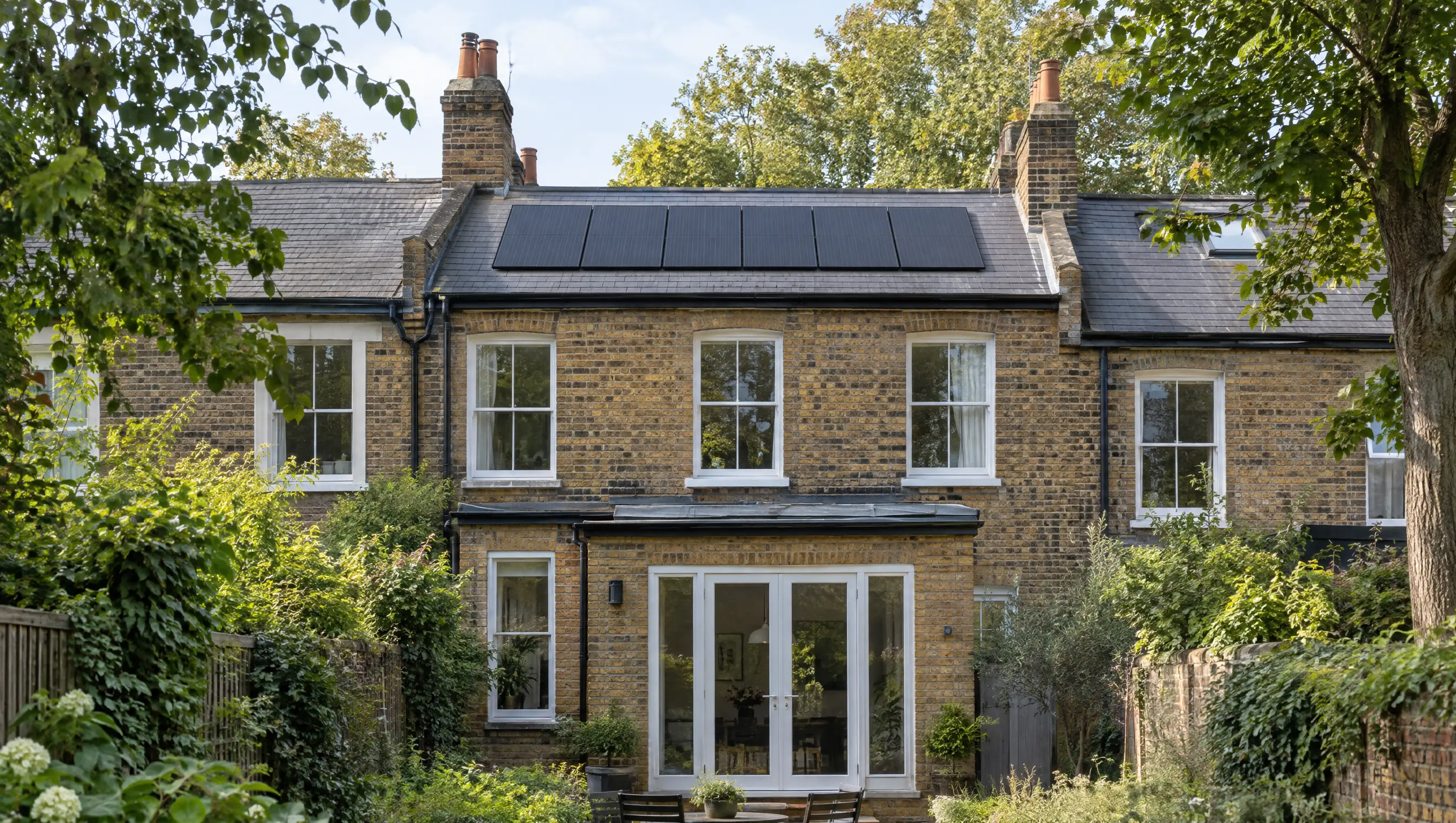
For most London homes the answer is no. Solar panels on a house are usually permitted development, which means you can install them without a planning application. That remains true in a conservation area, which is a very common misconception.
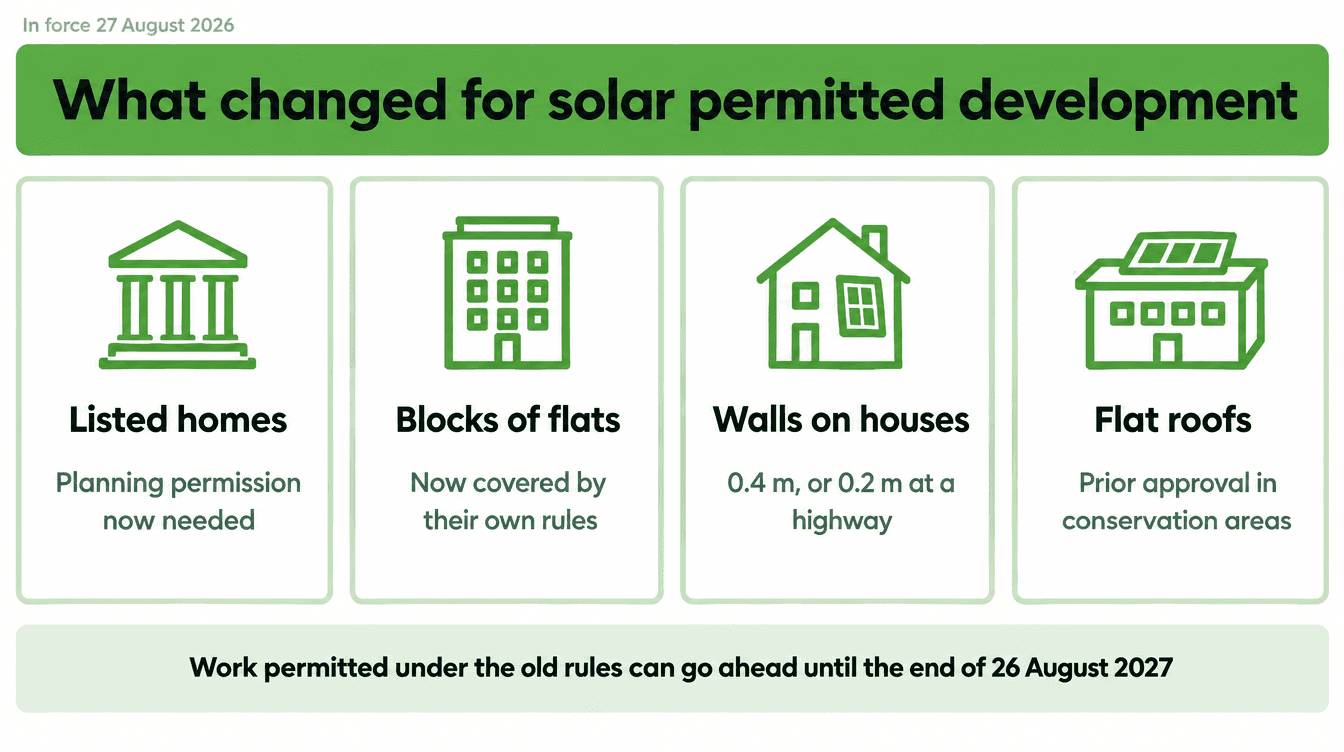
But the rules changed on 27 August 2026, and the changes matter. Blocks of flats have permitted development rights for solar for the first time. Houses gained more room on some walls. Listed homes now need planning permission as well as listed building consent. And flat roofs in conservation areas now need a short prior approval step.
Here is where the lines actually fall.
Key points
Solar on the roof of a house is permitted development, subject to size and siting limits, in most cases including in a conservation area.
The conservation area restriction applies to walls fronting a highway, not to the roof slope. A front roof slope facing the street is usually still permitted development.
Listed buildings are the real exception. Permitted development rights are removed, and listed building consent is needed as well as planning permission.
An Article 4 direction can remove permitted development rights in a defined area, but only for the rights it actually lists, and many London directions do not cover solar at all.
Since 27 August 2026, blocks of flats are covered. The right belongs to the block, not to an individual leaseholder, and freeholder consent is a separate matter.
Planning permission is not the same as Building Regulations, and neither is the same as your network operator's approval. All three can apply to one job.
The default position: permitted development
Solar equipment on a dwellinghouse, or on a building within its curtilage such as a garage, is permitted development under Part 14 of the General Permitted Development Order. The main limits for a house are:
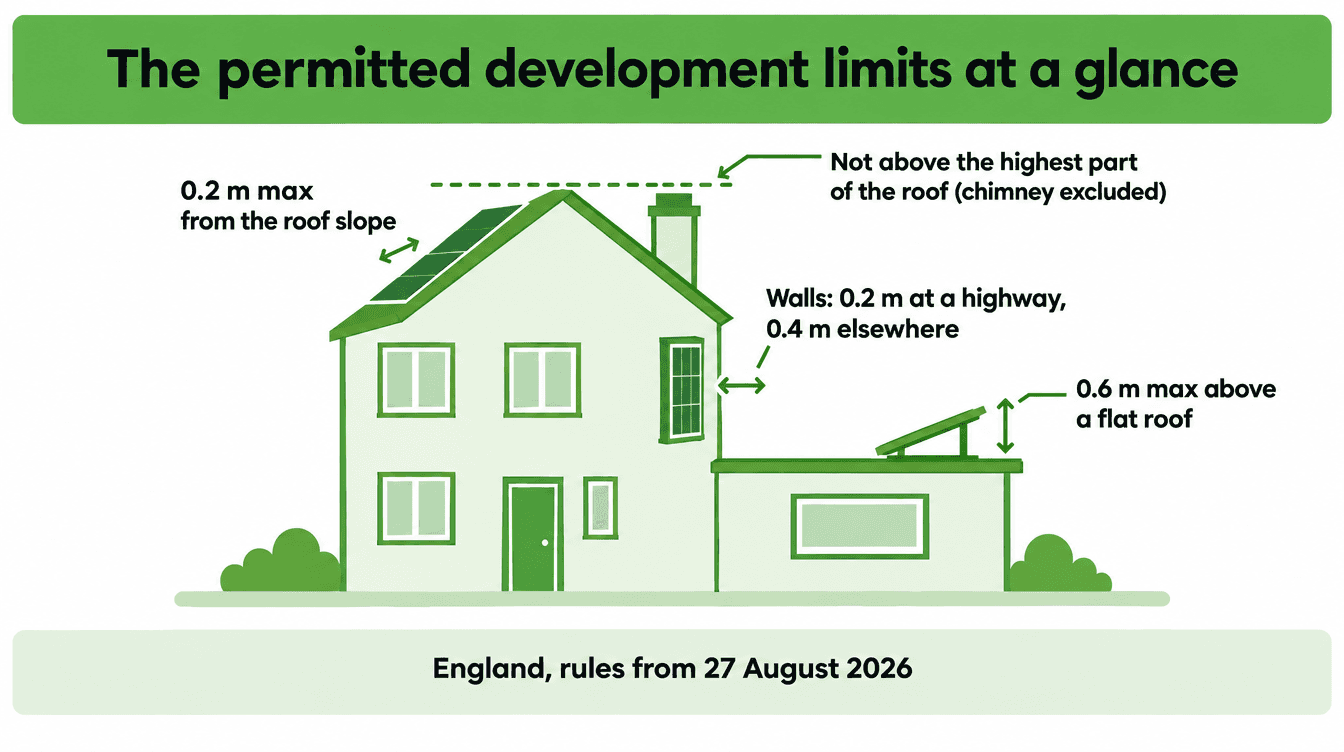
On a pitched roof, the equipment must not protrude more than 0.2 m beyond the plane of the roof slope, and its highest part must not be higher than the highest part of the roof, excluding the chimney.
On a flat roof, the equipment must not be more than 0.6 m higher than the highest part of the roof.
On a wall, the limit is 0.2 m where the wall abuts a highway, and 0.4 m otherwise. (The 0.4 m figure is new since 27 August 2026; the old rule was 0.2 m everywhere.)
It must not be on a scheduled monument, or on a listed building or a building within a listed building's curtilage.
There are also conditions attached to the right itself, and meeting the measurements is not enough on its own. The equipment must be sited, so far as practicable, to minimise its effect on the external appearance of the building and on the amenity of the area, and it must be removed as soon as reasonably practicable when no longer needed. Those are conditions of the permitted development right, so breaching them means the installation was not permitted development after all.
In practice, for a normal London house with panels lying flush on a pitched roof, all of this is comfortably satisfied. It is the edge cases below that need thought.
Conservation areas: what is actually restricted
This is the section worth reading twice, because the common belief is wrong and it stops people who could have solar tomorrow.
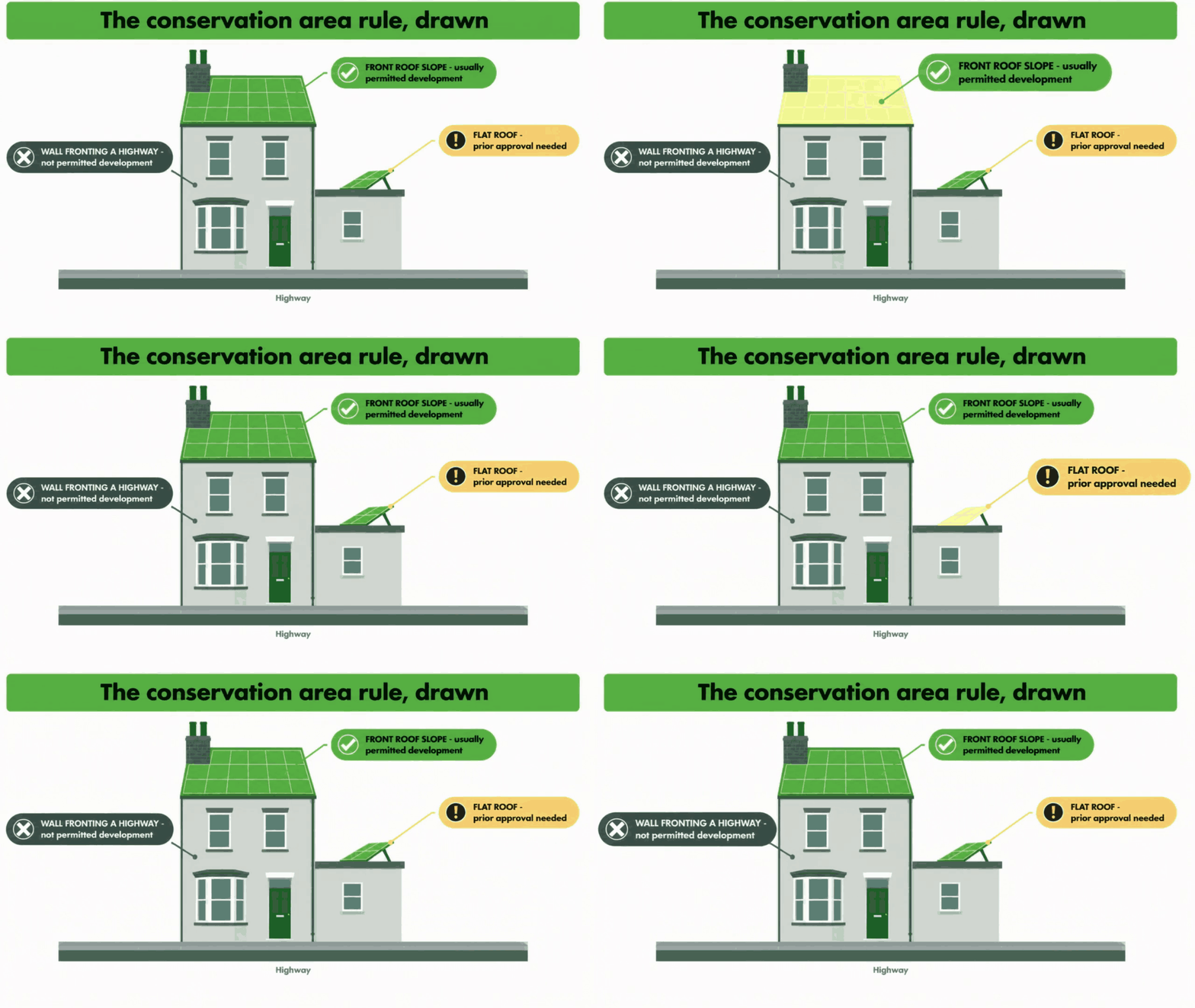
In a conservation area, the permitted development right for a house is lost where the equipment would be installed on a wall, balcony enclosure or roof enclosure which fronts a highway. For a block of flats it is narrower still: a wall which fronts a highway.
Read what that does not say. It does not restrict roof slopes.
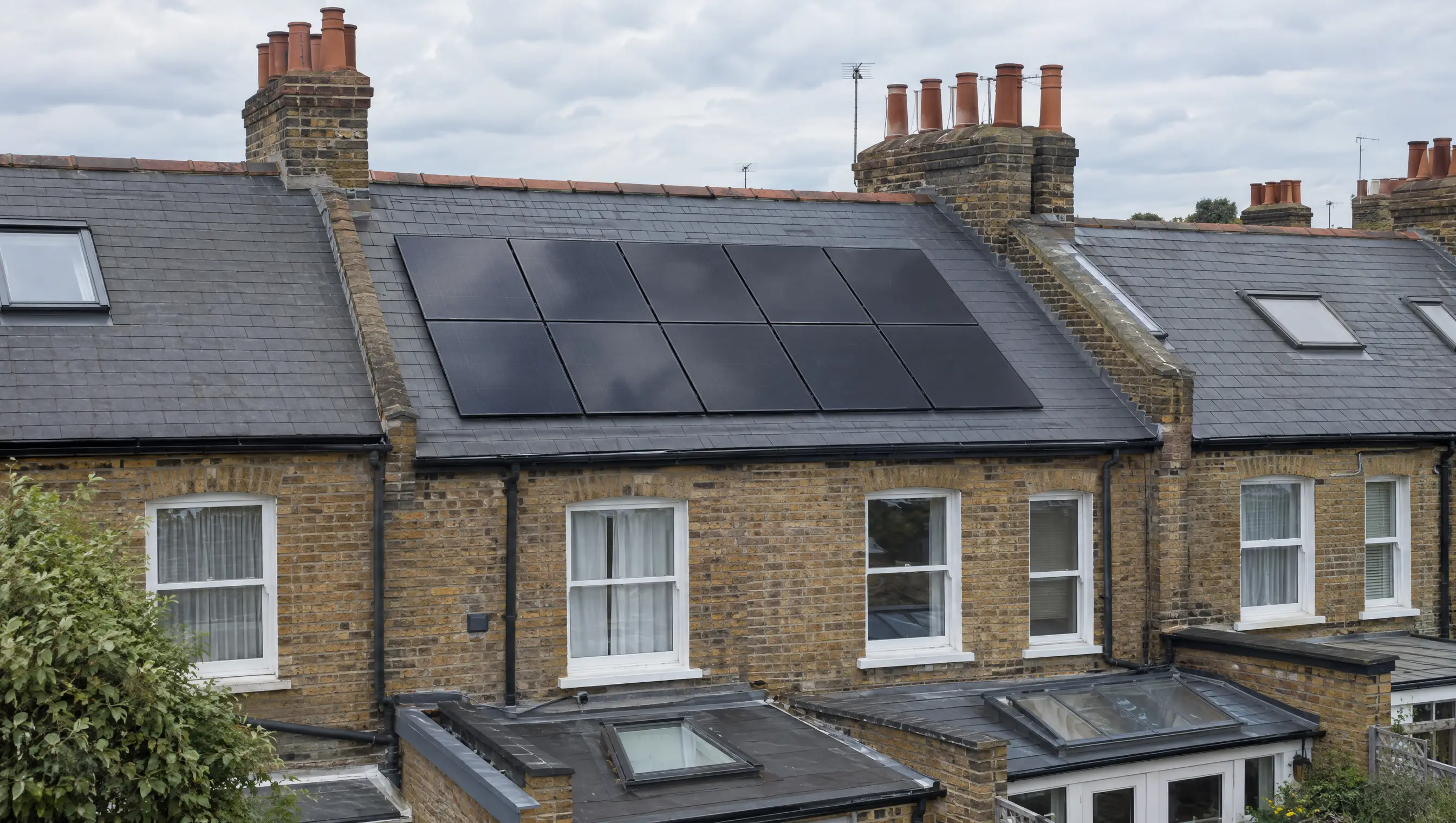
So for the classic London case (a Victorian or Edwardian terrace in a conservation area with the front roof slope facing the street) solar on that front roof slope is still permitted development, provided it meets the 0.2 m projection limit, does not sit above the ridge, and satisfies the siting conditions. Islington's own guidance for residents says exactly this: installation on a wall fronting a highway in a conservation area is not permitted development, while roof-slope installations remain permitted development.
Three things can still change that answer in a conservation area: an Article 4 direction (below), the building being listed (below), or the roof being flat.
The flat roof point is new. Since 27 August 2026, solar on a flat roof on conservation area land requires a prior approval application to the council before work begins, assessing the impact of the equipment's appearance on the area. That is not a full planning application. It is a shorter, narrower process with a defined determination period, but it is a step, and it applies to houses as well as flats. A flat-roofed rear extension on a terrace in a conservation area is squarely caught.
Article 4 directions: check, do not assume
A council can make an Article 4 direction removing permitted development rights across a defined area, and London has a lot of them. Where one applies to solar, you need a planning application.
The crucial point: an Article 4 direction only removes the rights it actually lists. Many London directions were made to control window replacements, front doors, roof alterations and external insulation, and say nothing about solar. Three real London examples make the point:
Camden shows why the date matters. Until June 2026, Camden's directions for the Hampstead, South Hampstead (formerly Swiss Cottage) and Belsize conservation areas removed solar rights. The replacement directions Camden adopted on 9 June 2026 no longer cover solar PV or solar thermal equipment, so roof-mounted solar there is now permitted development within the usual limits. Older guidance online may still say otherwise.
Islington has Article 4 directions in 40 of its 42 conservation areas, and they do not touch solar. Its own guidance states that its directions "only affect the permitted development rights relating to windows and external insulation."
Richmond upon Thames states it outright: "Some conservation areas are subject to Article 4 Directions. However, none of these Directions remove permitted development rights for solar panels."
So the answer depends on the specific direction for your specific area, and it can change when a council reviews its directions, as Camden's did in June 2026. Your council's planning pages list them, and it is a five-minute check. We do it as part of the survey.
One wrinkle if you look one up yourself: older directions refer to the class numbering of the 1995 order, where solar sat in Part 40. The equivalent in the current 2015 order is Part 14. A direction written against Part 40 still bites.
Listed buildings: the real exception
If your home is listed, the position is different in kind, not in degree.
Since 27 August 2026, permitted development rights for solar are removed on the listed house itself as well as on buildings within its curtilage. So you need planning permission, and separately you need listed building consent, because the Planning (Listed Buildings and Conservation Areas) Act 1990 requires authorisation for works that would affect a listed building's character as a building of special architectural or historic interest. Historic England is explicit that consent is required for installing any type of photovoltaic installation on a listed building.
What that does not mean is that the answer is no. Historic England's current position on solar and historic buildings is facilitative rather than prohibitive, and their own published advice includes case studies of solar on listed buildings at the highest grade. The things that tend to make a listed building application succeed are familiar: a location not visible from the public realm, an outbuilding or a rear slope rather than a principal elevation, reversible fixings, and a clear energy case.
It is also worth knowing that listed building consent can be needed for work that is not visible at all, where fabric is affected: cable routes, fixings and penetrations through historic structure. That is a conversation to have with the conservation officer early rather than late.
Practical advice: on a listed building, get pre-application advice from the council's conservation officer before designing anything. It costs less than a refused application and it usually tells you exactly what would be acceptable.
Flats: new rights since 27 August 2026
Until 27 August 2026, the permitted development right applied to a "dwellinghouse", which in planning terms does not include a flat. That meant solar on a block of flats needed planning permission, full stop.
The amendment that came into force on 27 August 2026 brought blocks of flats into Class A, with their own set of limits: generally tighter than those for houses, with a 0.2 m projection limit on both walls and pitched roof slopes, and no permitted development where the block is listed.
Two important qualifications:
The right belongs to the block, not to you personally. The order covers "a block of flats" and buildings in its curtilage. It does not give an individual leaseholder a right to install on a communal roof.
Planning is only one of the permissions you need. In most London blocks, the roof is retained by the freeholder rather than demised with a top-floor flat. So you will also need: the freeholder's or management company's consent, usually as a formal licence for alterations; a check of the lease's covenants on alterations and on the external appearance of the building; a collective decision where there is a right-to-manage or share-of-freehold structure; and possibly a party wall notice where the works affect a party structure. For taller blocks, building safety requirements add another layer.
None of that is a reason not to pursue it. It is a reason to start with the lease and the freeholder rather than with a quote.
There is also a transitional provision worth knowing about: anything that was permitted development under the old rules but is not under the new ones can still be carried out until the end of 26 August 2027.
Flat roofs, ground-mounted and battery storage
Flat roofs. The test is height, not projection: the equipment must not sit more than 0.6 m above the highest part of the roof. In practice a low-profile ballasted frame at a shallow tilt will usually stay inside that; a steep tilt frame frequently will not. And on conservation area land, the prior approval step applies.
Ground-mounted. There is a separate permitted development class for stand-alone solar in the curtilage of a house, with limits on the number of installations, the panel area, and how close it can be to a boundary, plus tighter rules in conservation areas and a prior approval requirement in some cases. It is rarely the answer in London, where garden space is the constraint, but our article on ground-mounted solar covers the design side.
Battery storage. There is no permitted development class specifically for domestic battery storage, and no government guidance stating whether one is needed, so be sceptical of anyone who tells you flatly that batteries never need planning permission. The realistic position is that a battery installed inside the property is generally not development at all and needs no permission; an external battery or its housing is more likely to need consideration, particularly on a highway-facing elevation in a conservation area; and on a listed building, listed building consent is very likely to be required, including for internal work that affects fabric. We flag anything that needs checking at survey. What is certain is that fire safety and Building Regulations apply either way, and the placement rules for home batteries are covered on our battery storage page.
Commercial roofs are a different regime
For non-domestic buildings there is a separate class, and it became considerably more generous in December 2023 when the 1 MW capacity cap on rooftop solar was removed. The limits now are dimensional rather than capacity-based: a 200 mm projection from a wall or pitched roof slope, 1 m above a flat roof, and a setback from the roof edge, with prior approval required for larger, non-microgeneration installations, covering design and appearance including glare. Listed buildings and scheduled monuments are excluded as with domestic.
For a warehouse or an office roof, this means the planning question is usually straightforward and the real constraints are structural and electrical. Our commercial solar pages cover what that involves by sector.
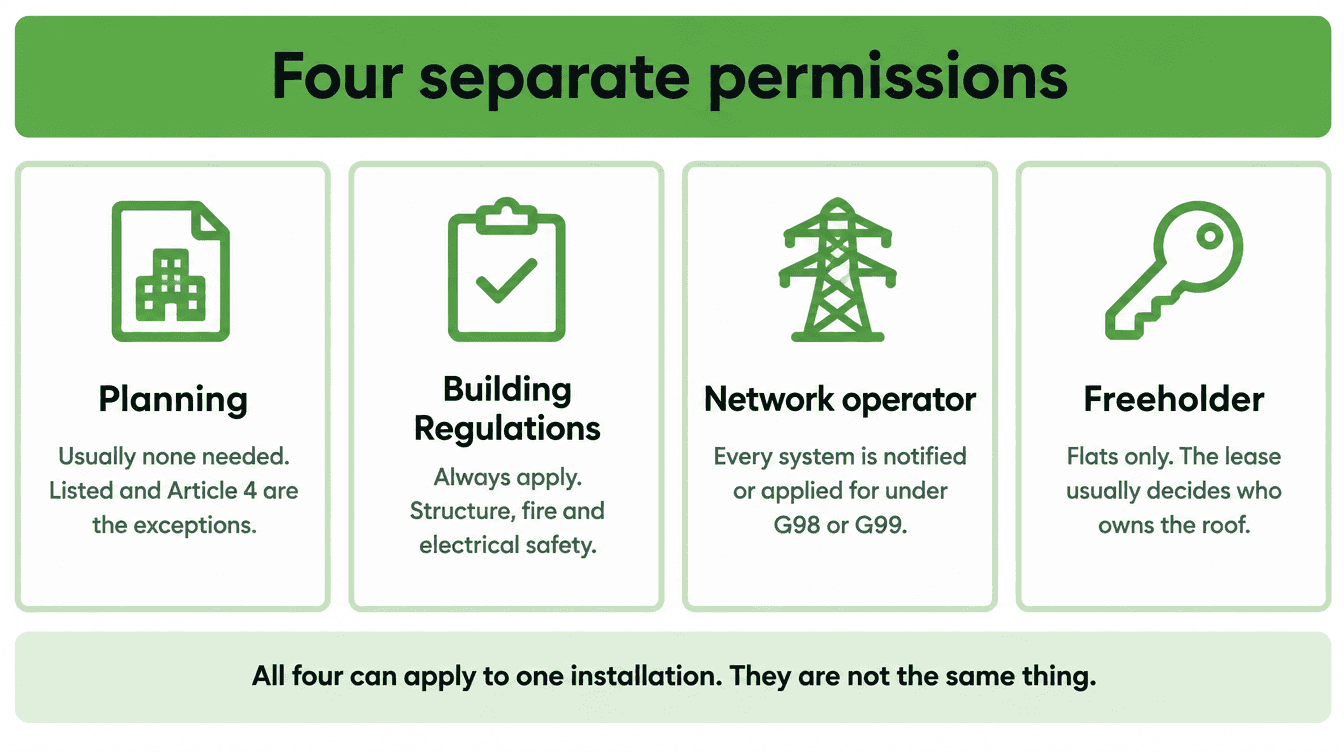
Planning is not the only permission
Several separate systems can apply to one solar installation, and people conflate them constantly.
Planning permission is about land use and appearance. Permitted development means you do not need an application.
Building Regulations apply regardless. Permitted development does not exempt anything. The relevant parts are structural (the roof has to be able to carry the load, which on older London housing stock is a real check, not a formality), fire safety, and electrical safety in dwellings. The electrical work is either notified to building control or self-certified by an installer registered with an authorised competent person scheme. A point worth being precise about: MCS is not a competent person scheme. MCS certifies the installation and is what gives you access to export payments and the VAT relief; Part P self-certification is a separate registration, which SPL holds through NAPIT.
Your electricity network operator has to approve or be notified of the connection, under G98 or G99. That is a third, entirely separate consent, and it is explained in our guide to G98, G99 and grid connection.
If your roof needs work before the panels go on, that is a fourth conversation: see roofing.
If you do need an application
Get pre-application advice first, especially for a listed building, a conservation area case, or a flat roof. Every London borough offers it, it is chargeable, and it is the cheapest way to find out what would be acceptable.
A householder planning application is determined within eight weeks as a statutory standard, and a prior approval application runs to a shorter defined period. Fees are set nationally and published on the Planning Portal; they are index-linked and change most years.
Consider a lawful development certificate even when you are confident the works are permitted development. It is a formal confirmation from the council that what you are proposing is lawful, it is cheaper than a full application, and it is useful at resale: a buyer's solicitor asking about solar on a conservation area roof is a much easier conversation with a certificate in the file.
What has changed recently, and what has not
Because this area moves, here is the current state as at September 2026:
27 August 2026: Part 14 rewritten. Listed homes no longer have permitted development rights for solar on the house itself; blocks of flats brought into Class A; houses gained the 0.4 m wall limit away from a highway; flat roofs on conservation area land now need prior approval; plug-in solar defined and restricted on timber walls, balconies and cladding. Transitional protection for previously permitted development runs to the end of 26 August 2027.
21 December 2023: the 1 MW cap on non-domestic rooftop solar removed.
Plug-in solar: the planning side is now in place, but the technical standards side is not. The government announced in March 2026 that it is working with the Energy Networks Association, network operators and Ofgem to amend the connection rules and the wiring regulations to allow sub-800 W plug-in solar to be connected to a domestic socket. Until that lands, the electrical route is not settled, and we would not fit one.
The Future Homes Standard: the regulations were made in March 2026 and come into force on 24 March 2027, requiring on-site renewable generation on new dwellings. It applies to new homes only and has no effect on retrofitting solar to an existing London house. If you are designing new homes, our article for architects and developers is the place to start.
Frequently asked questions
I live in a conservation area. Can I have solar on the front of my roof?
Usually yes. The conservation area restriction applies to walls fronting a highway, not to roof slopes. Check whether an Article 4 direction applies to your area and whether the building is listed, and confirm the installation meets the projection and ridge-height limits.
Do I need to tell the council if it is permitted development?
No planning application is required. But Building Regulations still apply and the electrical work is notified or self-certified, and your network operator has to be told about the connection. A lawful development certificate is optional and often worth having.
My neighbour was refused. Does that mean I will be?
Not necessarily. Refusals in London are usually about a listed building, an Article 4 direction, a wall-mounted installation, or a design that breached the siting conditions. Different street, different designation, different answer.
Can my council make me take them down?
If the installation was permitted development and complied with the conditions, no. If it was not (on a listed building without consent, in an Article 4 area without permission, or breaching the limits) enforcement is possible, and on a listed building unauthorised works are a criminal offence. This is why the five minutes of checking before installation matters.
Does solar affect my house insurance or my mortgage?
That is a question for your insurer and your lender rather than for us, and we would rather say so than guess. What we can tell you is that a properly certified, properly consented installation with its MCS certificate and paperwork in order is the version that causes no difficulty.
We are a block of flats. Where do we start?
With the lease and the freeholder, not with a quote. Establish who owns the roof and what the lease says about alterations. Once that is clear, the planning position since August 2026 is considerably more helpful than it used to be, and we can survey and design around it.
Do you handle the planning application?
We advise on whether one is needed and what the constraints are, as part of the survey. For a listed building or a case needing full permission, we work alongside your architect or planning consultant, who is the right person to prepare and submit it.
Find out where you stand
If you are in a conservation area, in a listed building, or in a flat, the honest answer is that it depends on your specific address, and we will check it before quoting, not after. Tell us your postcode and roughly what you are thinking, and we will tell you what applies.
Request a solar survey and quotation or call 020 3026 5032.
Facts in this article were checked against legislation.gov.uk, GOV.UK planning guidance, the Planning Portal, Historic England and London borough sources, and reflect the amendments in force from 27 August 2026. Planning rules change, and the borough-level position changes more often than the national one. This article is general guidance, not planning advice for your property. We cover every London borough and the surrounding counties.
Latest Articles






Ready to Start Saving with Solar?
Get your free no-obligation quote today. Our experts will design the perfect system for your home.
Free Home Survey
MCS Certified
Finance Available


Quick Links
Services
Contact
© 2026 Solar Panels London. All rights reserved.