Rated 4.8 on Trustpilot
Read Reviews

·
Battery Storage
What Actually Keeps Working in a Power Cut?
Most solar and battery systems switch off in a power cut, by design. Why, what an EPS output actually runs, how whole-home backup differs, and why it is decided before installation.
By
Solar Panels London
·
Last reviewed
If the grid goes down, a standard solar and battery system goes down with it. The panels stop, the battery stops, and the house is dark like everyone else's, even on a bright afternoon with a full battery. That is not a fault and it is not a cheap system. It is a safety requirement, and it applies to every grid-connected solar installation in the country unless backup has been deliberately designed and built in.
There are two ways to change that, and they are very different from each other. This article explains what each one actually gives you, what it will and will not run, and why the decision is best made before the installation rather than after.
Key points
A standard solar or battery installation disconnects when the grid fails, because it is not permitted to push electricity into a network that engineers may be working on.
EPS (emergency power supply) is an output on the inverter that feeds a small number of chosen circuits. What it can run is set by the inverter's EPS rating; how long it runs is set by the battery.
Whole-home backup uses a gateway between the grid and your consumer unit, so the house carries on as normal, within the limits of what the battery and inverter can supply at that moment.
Whether your panels keep producing during the outage depends on how the battery is connected. On a hybrid system they usually can. On an AC-coupled retrofit, do not assume it.
Backup changes the earthing arrangement, the wiring and the network paperwork. It is best designed in at survey rather than bolted on afterwards.
Why a normal system shuts down
Every grid-connected inverter in Great Britain has to include loss of mains protection. The engineering recommendation that governs small generators, EREC G98, puts it plainly: loss of mains protection "shall be incorporated and tested".
The reason is simple and worth knowing. When the local network fails, engineers may be working on cables and equipment that are supposed to be dead. If thousands of homes kept exporting solar into that network, the network would not be dead. So every inverter watches the supply continuously, voltage and frequency, and disconnects within a fraction of a second when the grid goes away.
That protection is not optional and it is not something an installer can turn off. What is allowed is a backup output that is physically and electrically separated from the network, so it can energise your circuits without energising anything outside your house. That separation is the whole engineering problem, and it is what you are paying for when you buy backup.
EPS: a few circuits, not the house
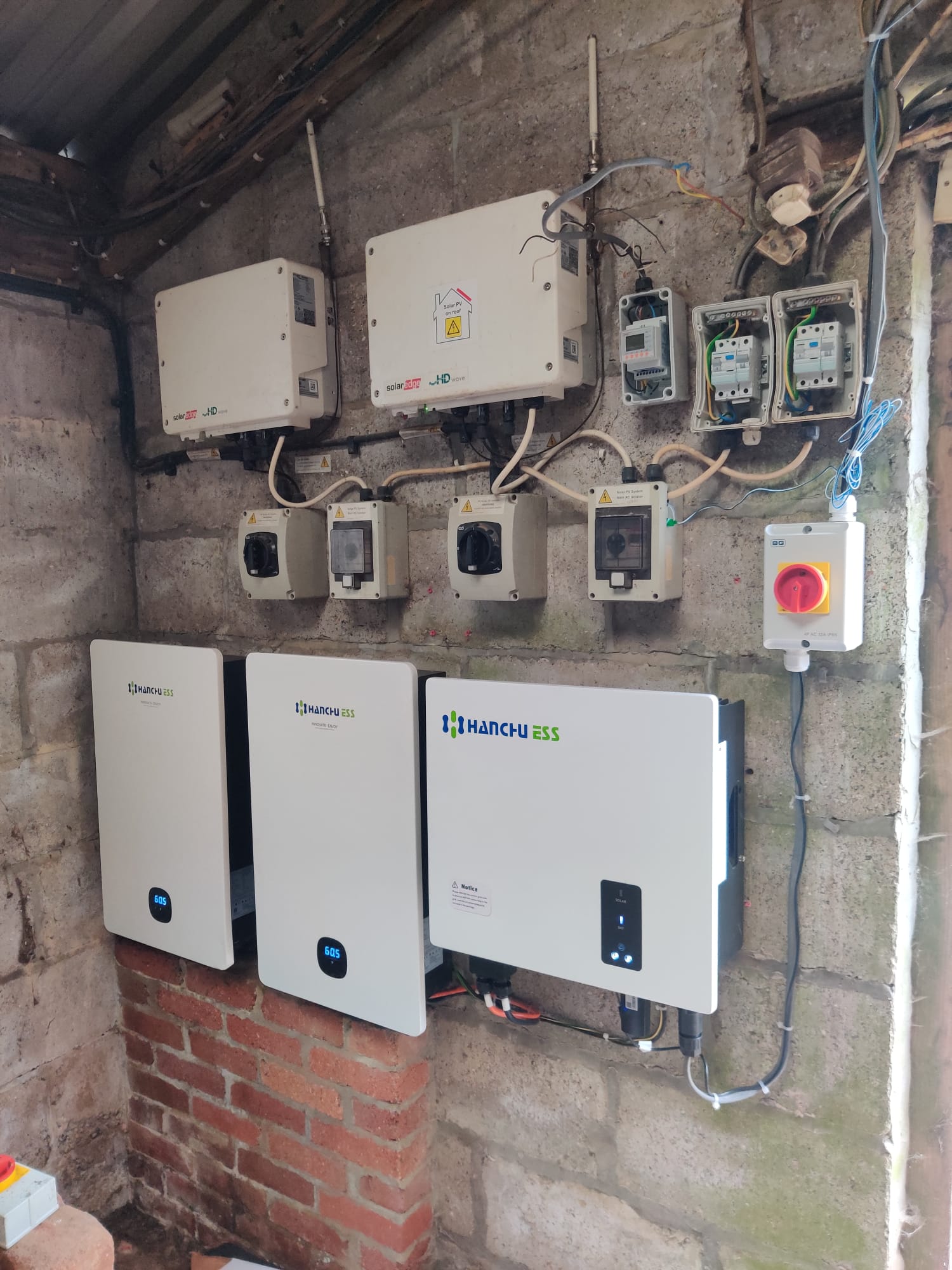
Many hybrid inverters have an EPS output, sometimes called emergency power supply, backup output, or island mode. It is a separate terminal on the inverter. When the grid fails, the inverter isolates itself from the network and starts supplying that output from the battery.
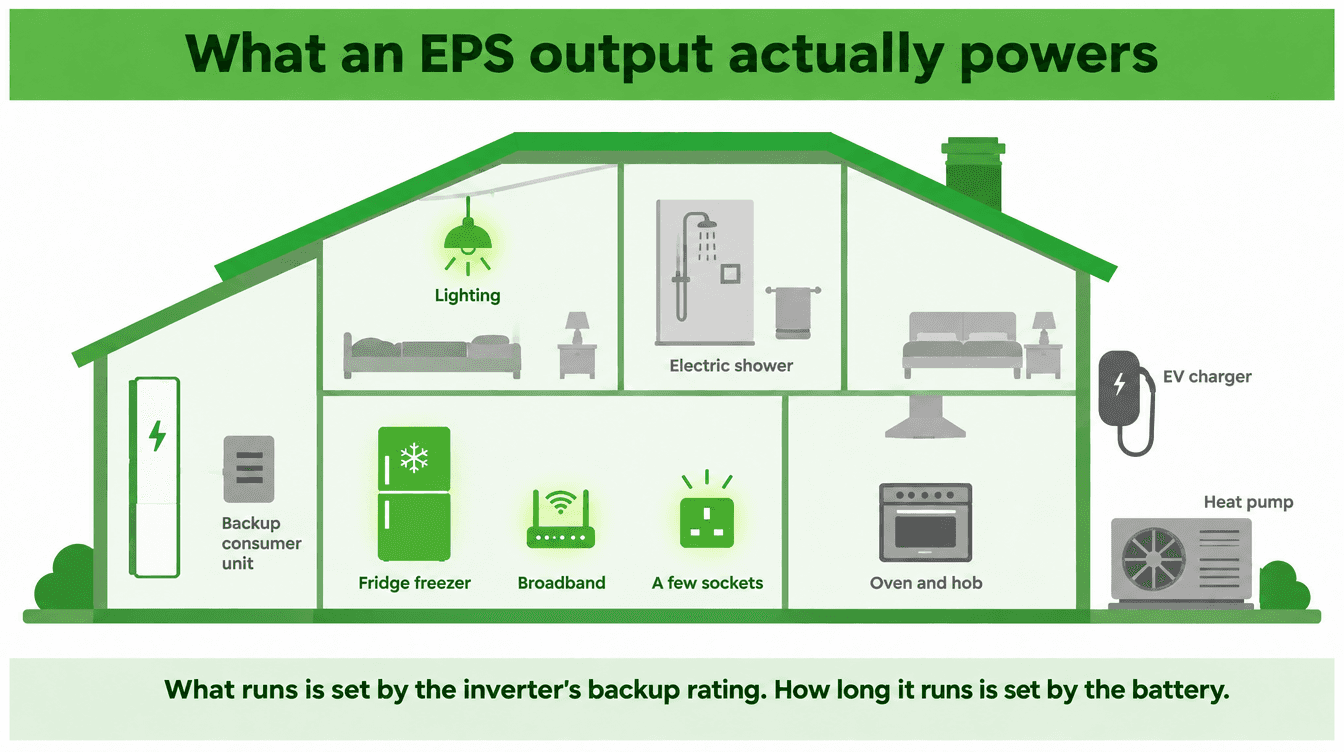
What it feeds is decided at installation. It can be a single socket, or more usefully a small backup consumer unit wired to the circuits you actually want: lighting, the fridge-freezer, the router, a few sockets, the boiler's control circuit. Everything else in the house stays off until the grid returns.
Three things about EPS catch people out.
What runs is set by the inverter, not the battery. The EPS output has a power rating in kW or kVA, and that rating is what decides whether something will run, not how many kWh are sitting in the battery. A battery with plenty of charge will still trip the backup if you switch on a load that exceeds the output rating. On some products the available backup power also depends on how many battery modules are fitted, so a larger battery buys more backup power as well as more backup time.
Motor loads are harder than they look. Manufacturers are explicit that starting currents can be several times the running current, and that some motor loads are not supported at all on the backup output. A fridge or freezer compressor starting up draws far more than it draws running. A heat pump or a pump is a bigger version of the same problem.
An overload does not just trip that circuit. On typical equipment, exceeding the EPS rating shuts the whole backup down, and some inverters then lock it out for several minutes or until someone restarts it manually. So the kettle you put on out of habit can take the lights out too. This is worth knowing before you live through it in the dark.
As a rough guide, on a typical single-phase domestic EPS output you should not plan to run an electric shower, an immersion heater, an electric oven or hob, an EV charger, or a heat pump. Lighting, refrigeration, broadband, computers, a TV and ordinary sockets are what EPS is for.
Whole-home backup: the house carries on
The other route is a gateway. It sits between the incoming grid supply and your consumer unit, and when the grid fails it disconnects the house from the network and lets the battery system supply everything on the other side of it. Nothing is separated out into a special backup circuit, because the whole board is the backup circuit.
On a Sigenergy SigenStor system this is done with the Sigen Gateway. Sigenergy's published figures for the single-phase Sigen Gateway Home give a backup switchover of 2 ms, and 0 ms for the three-phase version, fast enough that a computer will not notice. Larger versions of the gateway are rated for 100 A single-phase backup.
The honest caveat, and Sigenergy states it themselves: the gateway is a switch, not a power source. Whole-home backup means the whole house stays connected, not that the house has unlimited power. What the house can actually draw during the outage is still limited by the inverter's output and the energy in the battery. A 100 A backup connection does not mean 100 A of available power. If the household carries on as though nothing happened (oven on, shower running), a battery will empty quickly.
So the useful way to think about the two options is:
EPS decides in advance what matters, and keeps those things running for as long as the battery lasts.
Whole-home backup keeps everything available and leaves the choices to you, at the cost of more equipment and more electrical work.

Do the solar panels keep producing during the outage?
This is worth being precise about.
On a hybrid system, the panels are connected on the DC side of the same inverter that is running the backup. So the array can supply the backed-up loads and recharge the battery while the grid is down, which in daylight can extend a power cut from hours into days. A battery is still needed: the panels alone cannot hold the backup up, because a passing cloud would collapse it. Manufacturers say this explicitly: a battery is required for EPS operation.
On an AC-coupled retrofit, where your existing solar inverter is separate from the battery inverter, it depends entirely on the equipment. Your original solar inverter has its own loss of mains protection and will shut down when the grid fails. Whether it restarts and contributes during the outage depends on whether the battery inverter can form a stable supply for it to synchronise to, and can throttle it back when the battery is full. Some combinations do this; some do not. At least one major manufacturer's own documentation lists solar contribution during backup as not available on their AC-coupled product.
So do not assume it. If you have existing solar and you want backup that keeps working through a long daylight outage, that is a specific question to ask about your specific equipment at survey. It is one of the practical arguments for a hybrid replacement rather than an AC-coupled addition, and it is covered in more detail in our guide to adding a battery to existing solar panels.
The part that matters most: earthing
This is the section that separates a properly designed backup installation from a badly done one, and it is the reason backup costs more than "wiring a socket to the inverter".
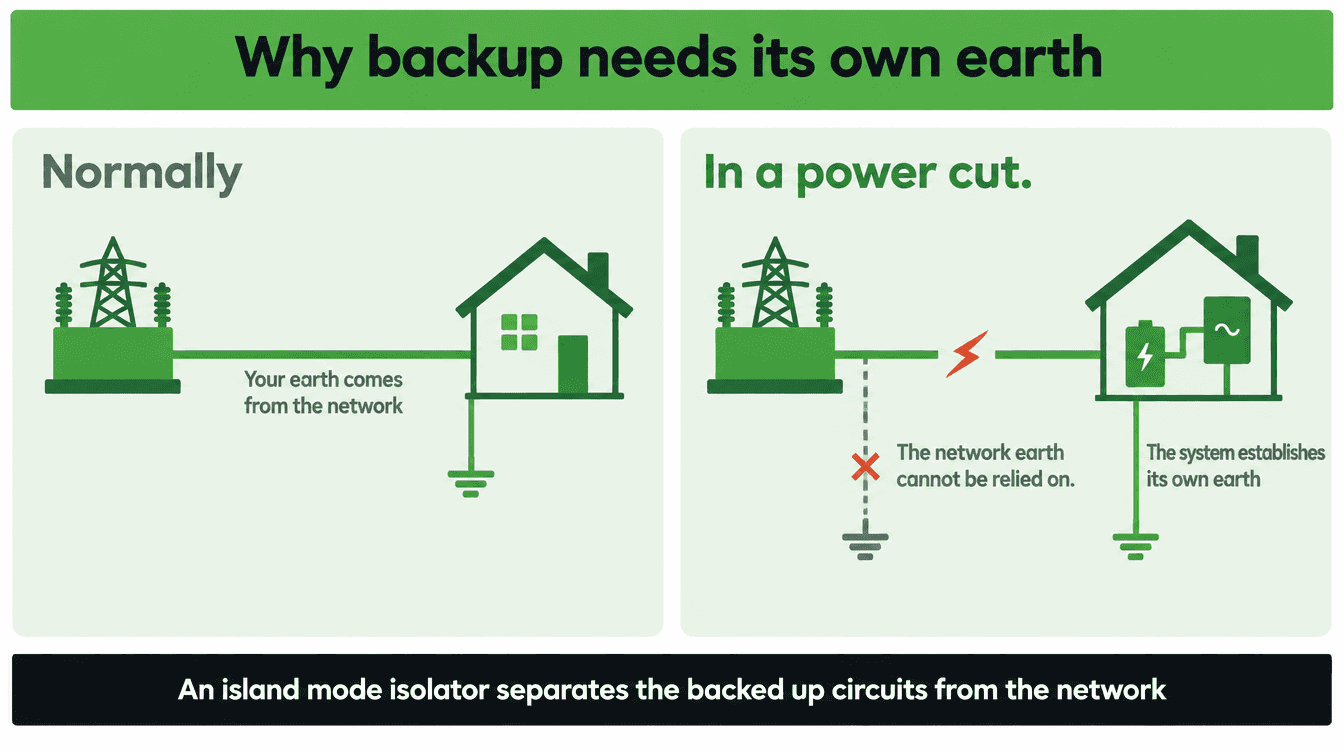
Many London homes are on a PME supply, where the house's earth is provided by the electricity network and made at the incoming service head. In a power cut that earth reference cannot be relied on. So when the system islands, it has to stop depending on the network's earthing and establish its own for the part of the installation it is supplying.
The MCS battery installation standard, MIS 3012, sets this out directly. The islanded part of the installation has to be isolated from the grid supply with an island mode isolator. Protection against electric shock "shall not rely on the distributor's means of earthing". The preferred arrangement in island mode is TN-S, usually achieved by the inverter making its own neutral-to-earth bond when it islands, and where that is not practicable, TT, meaning a local earth electrode installed at the property.
In plain English: without this, protective devices may not disconnect correctly during a fault while you are running on backup, and metalwork may not be at a safe potential. It is not a detail. If you are comparing quotes for a system with backup, ask how the island mode earthing is arranged. A good installer will have an answer ready.
What this means for your DNO paperwork
Solar and battery systems are notified to your network operator (for most of London, UK Power Networks) under the engineering recommendations G98 or G99. A system that is designed to operate in island mode is treated differently from a straightforward grid-parallel one: EREC G98 puts islanded installations outside its own scope and directs them to G99, which is an application approved before the work rather than a notification afterwards.
In practice the route depends on the equipment and on the network operator's own process, and it is your installer's job to establish it and submit it, not yours. The point for you as a customer is that backup is part of the application, so it belongs in the conversation at quote stage. Our guide to G98, G99 and grid connection explains the whole process.
Is backup actually worth it in London?
We would rather say this plainly than sell you something on fear.
London's electricity supply is among the most reliable in the country. UK Power Networks' own published performance for 2024/25 reports customer minutes lost of 25.6 and describes customers as being off supply for less than half an hour a year on average, with London Power Networks the best performing of its three networks. On those numbers, backup will not pay for itself in avoided inconvenience.
People buy it anyway, and for good reasons: medical equipment that cannot stop, a home office where an outage costs a day's work, a freezer full of food, a household with young children, or simply not wanting to sit in the dark. Those are legitimate reasons and we will design for them. What we will not do is imply that power cuts are a growing crisis in order to sell a gateway.
If you do want it, the easiest time to have it is at installation. Adding a backup output or a gateway to a system that was not designed for it means revisiting the inverter choice, the consumer unit, the earthing arrangement and often the DNO submission.
What we need to know at survey
If backup matters to you, come to the survey with a rough answer to these:
Which circuits genuinely matter: lighting, fridge-freezer, broadband, a home office, a medical device, the heating controls.
Whether anything must never stop. Medical equipment changes the design and sometimes the recommendation.
How long you want it to last. A few hours of essentials is a different system from a day of near-normal running.
Whether you want the whole house or a chosen list. This decides EPS versus gateway more than anything else.
What the consumer unit and the meter position look like. Backup wiring needs space and access.
Whether you have existing solar, and what inverter it is. This decides whether the panels can contribute during an outage.
Frequently asked questions
Will my solar panels work in a power cut if I do not have a battery?
No. A solar-only system shuts down when the grid fails, for the same loss of mains reason. Solar without storage cannot provide backup, because there is nothing to hold the supply steady when a cloud passes.
How long will the battery run the house for?
There is no general answer, because it depends on two separate limits: how much power is being drawn at that moment, and how much energy is left in the battery. A fridge, a router and some lights is a completely different proposition from a house running normally. We model it from your actual usage at survey rather than quoting a headline figure.
Is there a gap when the power goes off?
With a whole-home gateway, the changeover can be fast enough that most equipment will not notice: Sigenergy publish 2 ms for the single-phase Sigen Gateway Home and 0 ms for the three-phase version. With an inverter EPS output there is usually a short break while the inverter isolates and restarts the output; on some older equipment that break is a few seconds. If you have something that must never see an interruption, say so, because it changes the recommendation.
Can I add backup to a battery I already have?
Sometimes. It depends on whether the inverter has an EPS output, whether it is wired out, and whether the earthing and consumer unit arrangements can be made compliant. It is a survey question, and the answer is occasionally that replacing the inverter is the sensible route.
Will the battery still work normally the rest of the time?
Yes. A system with backup behaves exactly like one without it while the grid is up: storing surplus solar, discharging in the evening and charging on a cheap overnight tariff if you have one. Backup is a capability that sits dormant until it is needed.
Does backup mean I can go off grid?
No. These systems are designed to ride through an outage, not to replace a grid connection. Running a house year-round on solar and storage in a UK winter is a completely different, and much larger, engineering problem.
Talk to us before you choose the inverter
Backup is one of the decisions in a solar installation that is hardest to change later. If it matters to you, tell us at the survey and we will design it in, show you which circuits it covers, and explain exactly what it will and will not run.
Request a solar and battery quotation or call 020 3026 5032.
Facts in this article were checked against Energy Networks Association, MCS and manufacturer documentation. Some of it is date-sensitive and we review it regularly. You can read more about the systems we install on our battery storage page.
Latest Articles






Ready to Start Saving with Solar?
Get your free no-obligation quote today. Our experts will design the perfect system for your home.
Free Home Survey
MCS Certified
Finance Available


Quick Links
Services
Contact
© 2026 Solar Panels London. All rights reserved.