Rated 4.8 on Trustpilot
Read Reviews

·
Battery Storage
Can You Add a Battery to Existing Solar Panels?
In most cases, yes. Here is how a battery is added to a solar system you already own, the two ways to connect it, and what it means for your Feed-in Tariff, DNO paperwork and VAT.
By
Solar Panels London
·
Last reviewed
Yes. In most cases a solar PV system that is already installed can have a battery added to it, including systems fitted by another company and older systems on the Feed-in Tariff. There are two ways to do it, and the right one depends on the age and type of your current inverter, whether you want backup power in a power cut, and how your generation meter is arranged. This guide explains both routes, what happens to your FIT payments, the DNO paperwork involved, and what a retrofit actually looks like on the day.
Key points
Almost any working solar system can take a battery. The question is usually which connection method suits it, not whether it is possible.
An AC-coupled battery leaves your existing solar inverter alone. Replacing the inverter with a hybrid gives you one unit running both, and makes sense when the old inverter is near the end of its life.
Your Feed-in Tariff generation payments continue if the battery is installed correctly and your FIT licensee is told. We fit a bidirectional generation meter on hybrid replacements so that grid electricity used to charge the battery is never counted as generation.
The battery inverter counts towards your grid connection limit, so most retrofits need a G99 application to the DNO before installation. We handle it.
Battery storage fitted in a home is zero-rated for VAT in Great Britain until 31 March 2027.
Two ways to add a battery to existing solar
Every home battery needs an inverter to convert between the DC electricity the battery stores and the AC electricity your house uses. Your existing solar inverter was designed for panels only, so a retrofit either adds a second inverter for the battery, or swaps the old inverter for one that does both jobs.
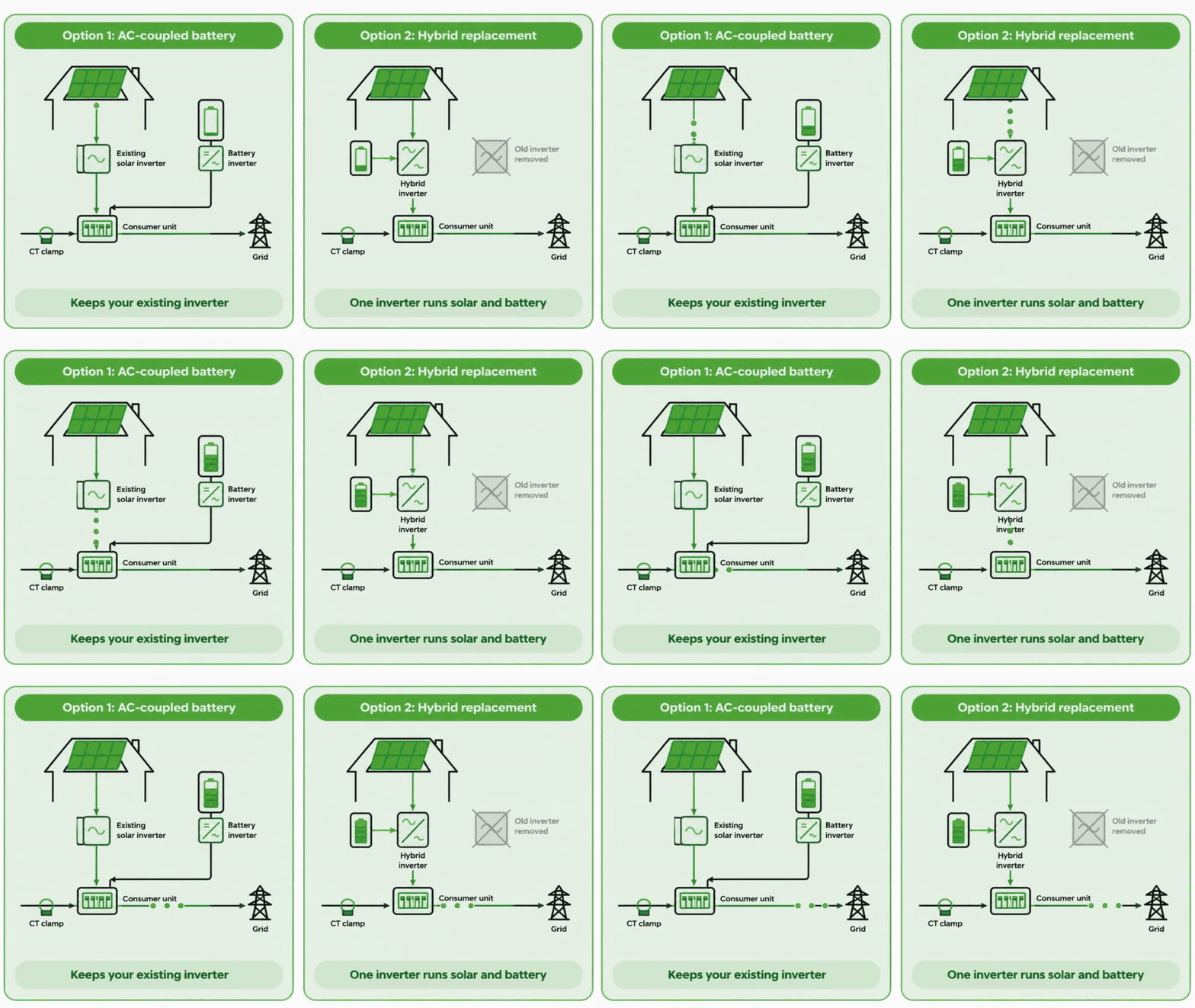
Option 1: AC-coupled battery (keep your existing inverter)
An AC-coupled battery comes with its own inverter, sometimes called an AC controller or battery inverter. It is wired into your home's electrics alongside your existing solar system, and a CT clamp (a current sensor) on your incoming supply tells it when the house is exporting surplus solar and when it is importing from the grid. The battery charges on the surplus and discharges in the evening.
Your solar inverter is not touched. This is usually the simplest retrofit, it keeps the manufacturer warranty on your existing inverter intact, and it is the route we normally recommend when the existing system is working well. It also sits on the house side of your FIT generation meter, which matters for the tariff, as explained below.
Option 2: Replace your inverter with a hybrid
A hybrid inverter runs both the panels and the battery. Your existing inverter is removed, the panels are connected to the new hybrid, and the battery connects to it directly on the DC side.
This route makes sense when your current inverter is around ten years old or more, when it has already failed, or when you want the tidiest system with one monitoring app and backup power built in. Many string inverters fitted in the FIT years are now at or beyond their expected working life, so for a lot of 2011 to 2016 systems this is the practical choice rather than paying to keep two inverters running. If your inverter has already stopped working, our inverter replacement service is the starting point, and a battery can be designed in at the same visit.
Because a hybrid replacement changes the equipment that sits before your generation meter, it needs a different metering arrangement to protect your FIT payments. That is the single most common thing other installers get wrong on retrofits, so it has its own section below.
Which one is right for you?
As a rule of thumb: a working inverter under about eight years old points to AC-coupled; an inverter that is failing, out of warranty or already dead points to a hybrid replacement. Between the two, the deciding factors are usually whether you want backup power, how much space you have, and the DNO position on your street. That is what the survey is for, and our written design tells you which route we have chosen and why.
What we check before quoting a retrofit
A retrofit quote written from a phone call is a guess. These are the things our surveyor looks at on site:
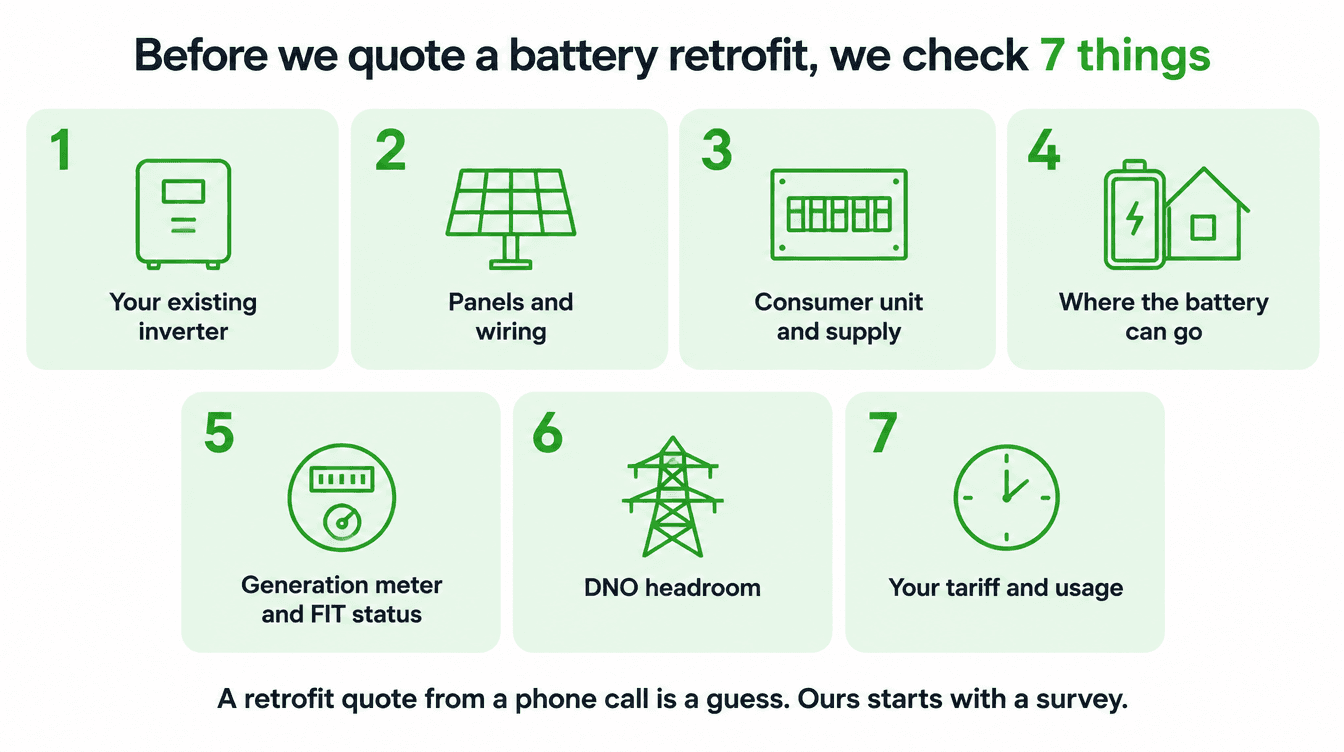
Your existing inverter. Make, model, age, whether it is still working properly, and whether the manufacturer still supports it. This decides the connection route more than anything else.
The panels and wiring. Panel count and total kWp, string configuration, condition of the DC isolators and cabling. An older system sometimes has faults that are worth fixing at the same time.
Your consumer unit and supply. Whether there is space and capacity for the battery circuit, and whether you are on a single-phase or three-phase supply.
Where the battery can go. Home batteries are installed to the fire safety specification PAS 63100:2024. In practice that rules out lofts and roof voids, escape routes such as hallways, stairs and landings, and bedrooms. Garages, utility rooms and suitable external walls are the usual answers. In a London terrace or flat this is often the deciding factor in the design.
Your generation meter and FIT status. Where the meter sits, whether you are on deemed or metered export, and who your FIT licensee is.
DNO headroom. What your existing system was registered as, and whether adding a battery inverter needs a G99 application before work starts.
Your tariff and usage. Whether you are on, or could move to, a time-of-use tariff, and how much electricity you use in the evening and overnight. This drives the battery size.
What happens to your Feed-in Tariff
This is the question we are asked most, so here is the position clearly.
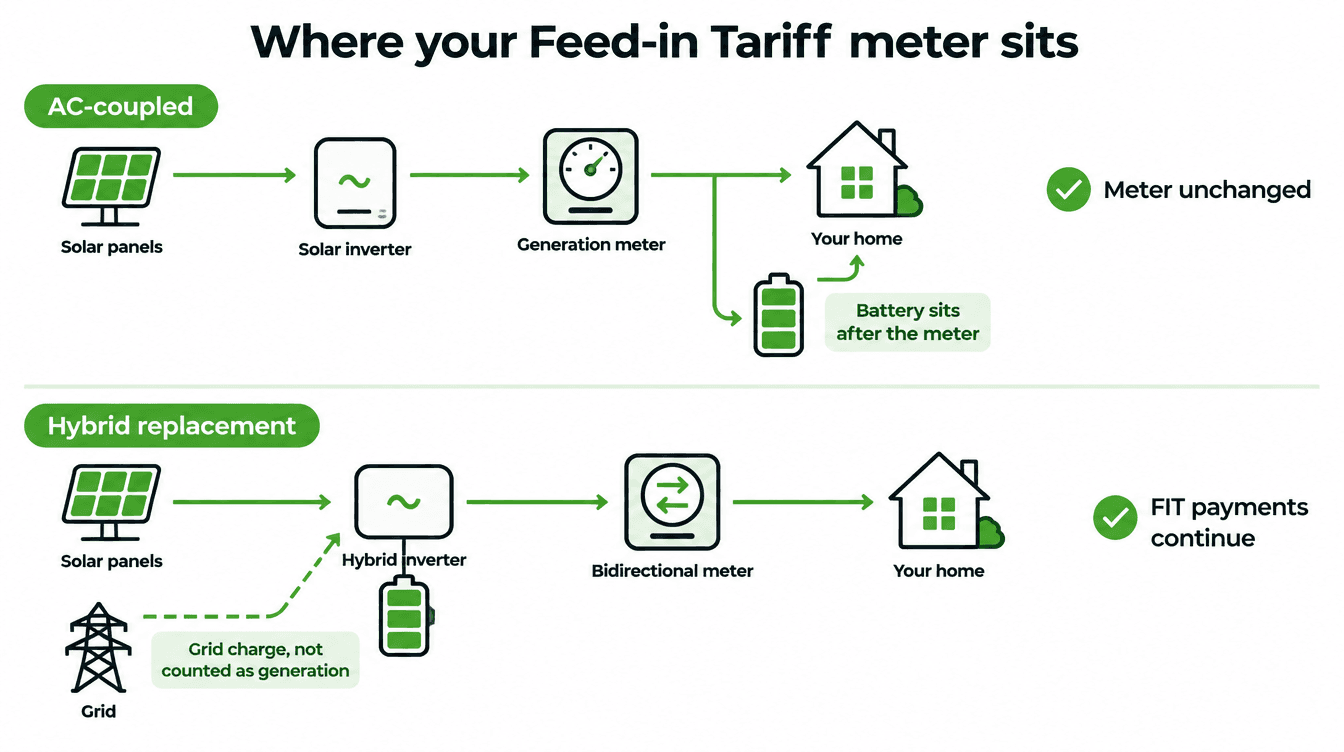
Adding a battery does not end your FIT payments. Ofgem's guidance for FIT generators says your accreditation and generation payments are not affected by adding storage, as long as your generation meter still measures only what your panels produce, separately from any other source. Two things follow from that:
With an AC-coupled battery, the battery sits after your generation meter on the house side. The meter carries on recording exactly what the panels generate, whether that electricity goes to the house, the battery or the grid. Nothing about the FIT arrangement changes.
With a hybrid replacement, the battery can be charged from the grid through the same inverter that the generation meter is measuring. If grid electricity charged into the battery and then discharged were counted as generation, you would be paid FIT for electricity you did not generate. So when we replace an inverter with a hybrid on a FIT system, we fit a bidirectional generation meter that calculates a net figure, so grid-charged electricity is never counted. That is the arrangement Ofgem's co-location guidance describes, and it is what your FIT licensee will want to see on the updated wiring diagram.
You must tell your FIT licensee. Ofgem requires FIT generators to notify their licensee when battery storage is connected to the accredited installation. Licensees typically ask for an updated single-line diagram and the meter details. We supply both as part of the handover pack, and we will tell you exactly what to send.
Deemed export. Most domestic FIT systems are paid for export on a deemed basis, meaning an assumed percentage of generation rather than a measured figure. Ofgem's guidance is that deemed export payments can continue where the generation meter still measures only the panels' output, and that this remains the case with co-located storage. In other words, a correctly installed retrofit does not force you onto metered export. Your licensee may still ask questions; that is normal, and the diagram answers them.
FIT and the Smart Export Guarantee. If you are on the FIT you can keep your generation payments and, if you choose, move your export payments to a Smart Export Guarantee tariff instead. You cannot receive both export payments at once, and for a small system the deemed 50% can be worth more than a measured export once a battery is soaking up your surplus. Ask us or your licensee before switching.
If you are not on the FIT (systems installed from April 2019 onwards, or older systems that never registered), none of this applies. You simply carry on with, or apply for, a SEG export tariff. Note that some SEG suppliers pay only for exported electricity that came from your panels rather than from grid charging, and may ask how your battery is configured. Our earlier guide to Octopus Flux covers one of the tariffs designed around solar and storage.
DNO approval for a battery retrofit
Your electricity network operator, which for most of London is UK Power Networks, treats a battery inverter as a generator in the same way as a solar inverter. The rule that matters is the 16 amps per phase limit (3.68 kW on a single-phase supply): up to that total across everything you have, the installer can connect and notify afterwards under G98. Above it, a G99 application has to be approved before installation.
The key word is total. If your existing solar inverter is already rated at 3.68 kW, as many FIT-era systems are, adding any battery inverter takes you over the limit, so most retrofits need a G99 application. Where the combined figure stays under 16 A, a G98 notification after the work may be enough. Either way the DNO has to be told what is now connected.
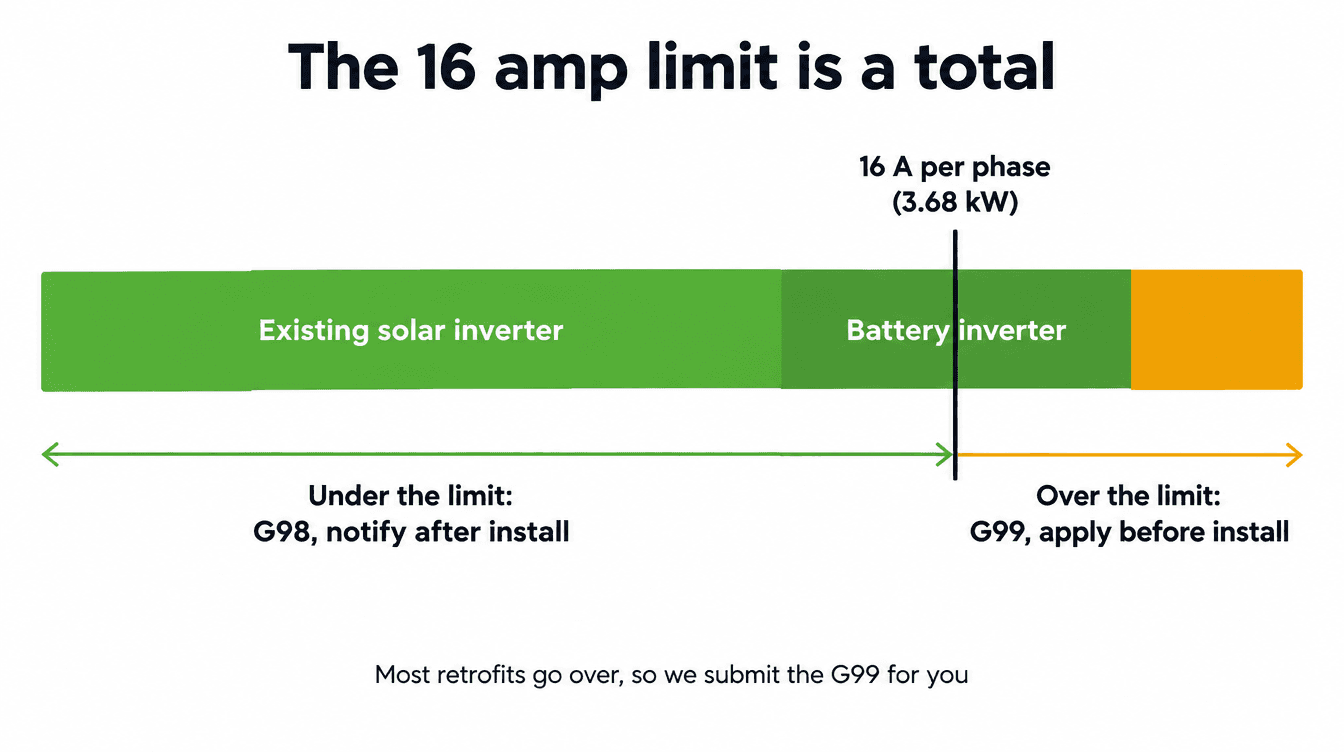
We submit the application, and where the DNO offers a fast-track route for small systems we use it. Approval times vary by network and by how busy your local substation is; allow several weeks and we will build it into the programme rather than promise a date we cannot control. If you want the background, our guide to DNOs, system size and export limits explains G98, G99 and export limiting in more detail.
MCS, certification and paperwork
MCS publishes a dedicated battery installation standard (MIS 3012), and we install to it. Your existing MCS certificate for the solar system stays valid; a retrofit does not require the original installation to be re-certified. Along with the DNO submission you receive the electrical installation certificate for the new circuit, the manufacturer warranty registration for the battery and inverter, the updated wiring diagram for your FIT licensee, and our written workmanship guarantee.
0% VAT on retrofit batteries until 31 March 2027
The installation of a battery in a home is zero-rated for VAT in Great Britain, and that includes a battery added to an existing solar system on its own. The zero rate runs until 31 March 2027; from 1 April 2027 it is due to return to the 5% reduced rate. Because the relief applies to the installed system, it covers the labour as well as the equipment.
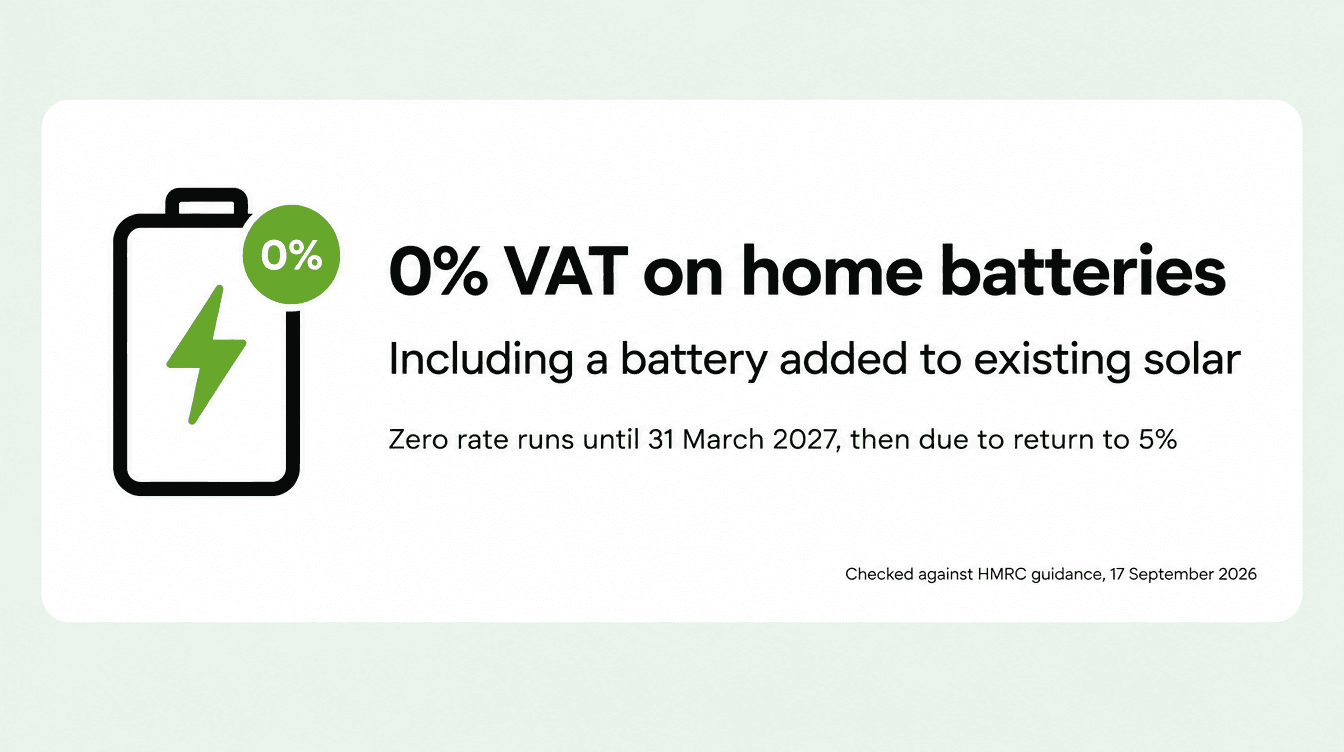
Checked against HMRC guidance on 17 September 2026. If the Autumn Budget changes the date, we will update this section.
Will the battery keep the lights on in a power cut?
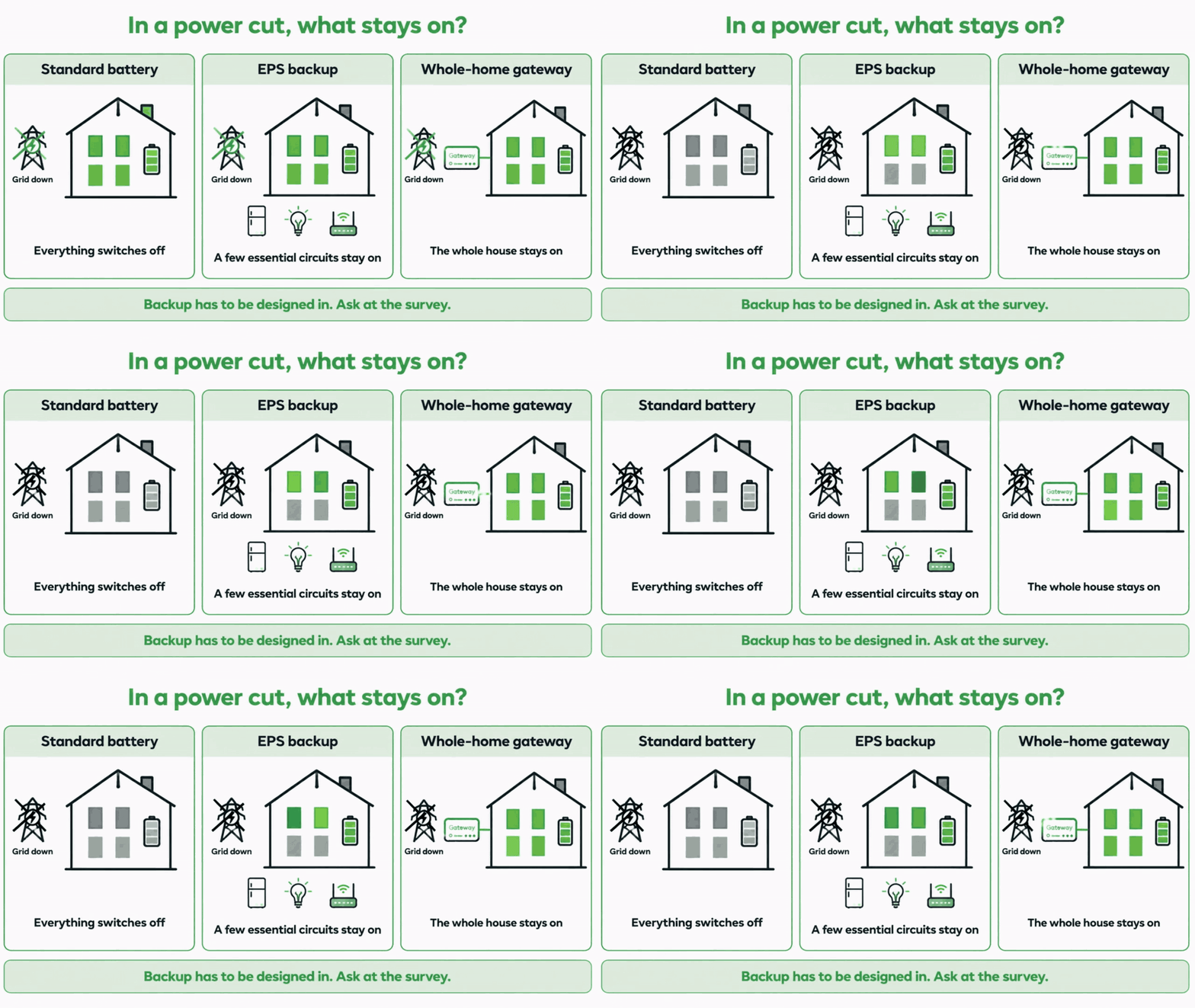
Only if it is designed to. A standard battery installation switches off in a power cut, exactly like a standard solar system, because it is not permitted to feed a dead grid. Backup has to be planned in at the design stage: either an EPS (emergency power supply) output on a compatible inverter that keeps a few essential circuits running, or a whole-home gateway. Both need extra electrical work, and an AC-coupled unit does not automatically provide either. If backup matters to you, say so at the survey; it can change which route we recommend. Our battery storage page explains the two levels of backup.
What size battery should you add?
There is no single right answer, which is why we size from a survey rather than a form. The size depends on how much electricity you use in the evening and overnight, the size of your existing array, whether you have or plan an EV charger or heat pump, and whether you are on a time-of-use tariff. Modular batteries such as FoxESS and Sigenergy can be expanded later within the limits of the inverter and the location, so if you expect your usage to grow, tell us and we will design in headroom rather than oversize on day one. Our article on whether solar batteries are worth it walks through the cause and effect behind the decision.
Can you add a battery to solar installed by another company?
Yes. A large share of retrofit enquiries we receive are for systems we did not install. We survey the existing system as we would our own, and in most cases an AC-coupled battery can be added without disturbing the original installation or its warranties. If the original installer has gone out of business, which is common for FIT-era systems, we can also take over servicing and monitoring of the whole system.
What the retrofit day looks like
Most single-battery retrofits are completed in a day. The battery and inverter are mounted, the new circuit is run to your consumer unit, the CT clamp is fitted at the meter position, and the system is commissioned and connected to its monitoring app. A hybrid replacement takes a little longer because the panels are reconnected to the new inverter and the bidirectional meter is fitted. Scaffolding is not normally needed for a battery retrofit, because nothing changes on the roof. Once the DNO submission and paperwork are done, we walk you through the app and set the charging schedule for your tariff.
The batteries we retrofit
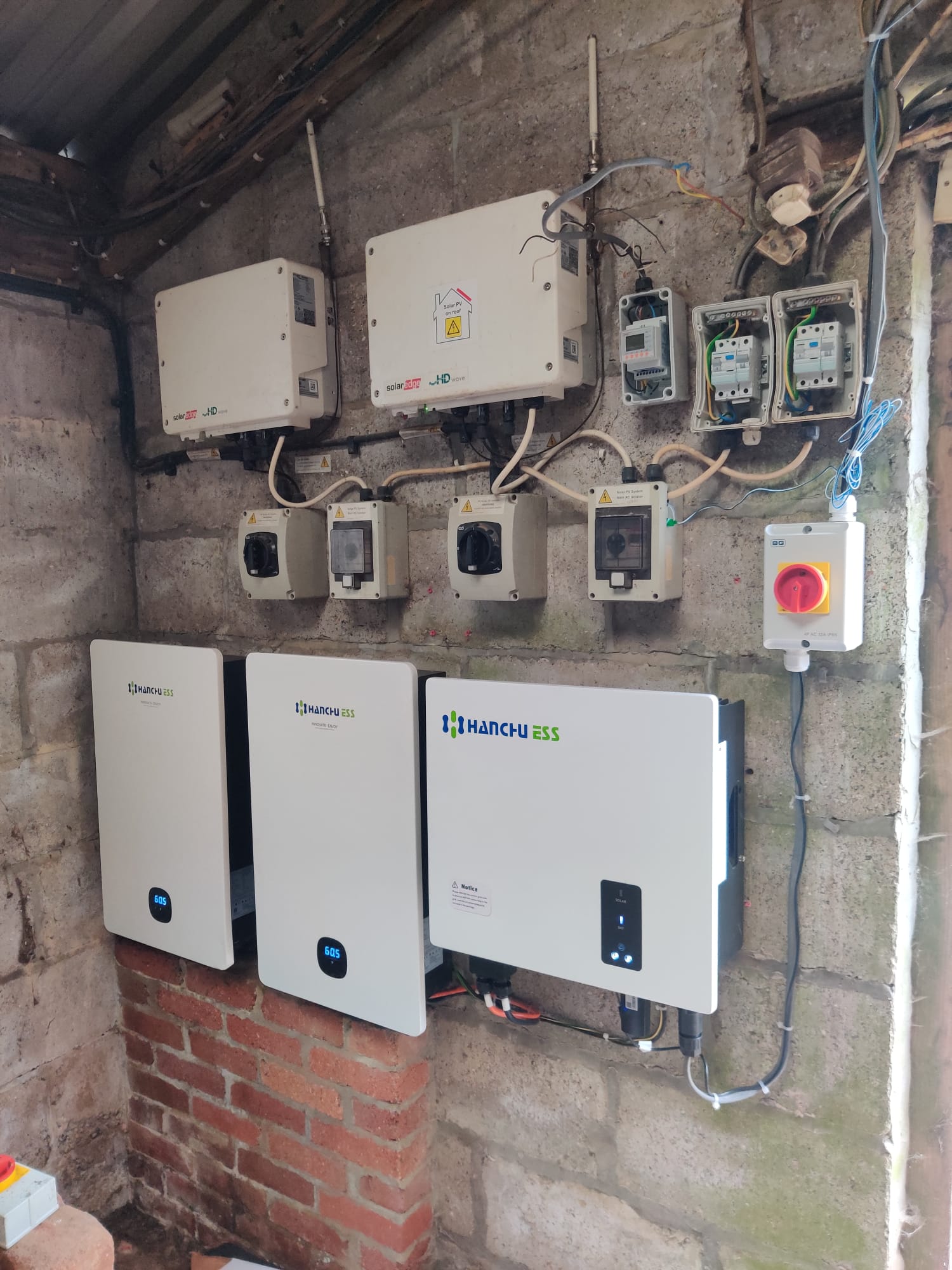
For AC-coupled retrofits we fit FoxESS AC-coupled inverters with FoxESS EP6, EP12 or CQ modular batteries, which are IP65 rated for garage or outdoor installation. Where a hybrid replacement is the better route, we fit FoxESS hybrid inverters with the same battery families, or a Sigenergy SigenStor system where you want the battery, inverter and optional EV charger in a single unit with whole-home backup. Hanchu batteries are our recommendation for cold or exposed locations. If you have a SolarEdge system, there are SolarEdge-compatible and AC-coupled options, and we will advise which fits at survey. All of these are lithium iron phosphate (LFP) batteries with ten-year manufacturer warranties on registration. Which one we recommend depends on the survey, and we will tell you why.
One of our recent installations, a solar and battery system in Milton Keynes fitted in April 2025, used a FoxESS hybrid inverter with a FoxESS EP battery. It is a new system rather than a retrofit, but the measured first-year results are on our case study page if you want to see how the same equipment behaves over a full year.
Frequently asked questions
Will adding a battery void my existing solar warranty?
An AC-coupled battery does not touch your solar inverter or panels, so their warranties are unaffected. A hybrid replacement retires the old inverter, so its warranty no longer matters; the panels' warranty is unaffected either way. Any workmanship guarantee from your original installer is theirs to honour, and we will not alter anything it covers without telling you.
Do I need planning permission to add a battery?
Domestic battery storage does not normally need planning permission. Listed buildings and some external locations in conservation areas can be exceptions, and we will flag anything that needs checking at survey.
Can the battery charge from the grid overnight?
Yes, on a time-of-use tariff. Both AC-coupled and hybrid systems can be scheduled to charge in the cheap window and discharge at peak. On a FIT system with a hybrid inverter this is exactly why the bidirectional meter is fitted.
How long does a battery last?
The LFP batteries we install carry ten-year manufacturer warranties and are designed for several thousand charge cycles. Capacity reduces gradually over time rather than failing suddenly.
My inverter is fine. Should I still go hybrid?
Usually not. If the inverter is working and supported, an AC-coupled battery keeps it in service and keeps its warranty. We recommend a hybrid replacement when the inverter is near the end of its life, has failed, or when you need backup power that only a hybrid can provide.
Does a battery affect my Feed-in Tariff if I already have a hybrid inverter?
Some systems installed late in the FIT period have a hybrid inverter that was fitted "battery ready". In that case the battery connects to the existing inverter on the DC side, and the metering question above still applies: your licensee needs to be satisfied that grid-charged electricity is not counted as generation. We check the existing meter arrangement and fit a bidirectional meter if needed.
Request a battery retrofit quotation
Tell us roughly when your solar was installed, what inverter you have if you know it, whether you are on the Feed-in Tariff, and your postcode. We will come out, survey the existing system, and send a written design showing the battery size, the connection route and where it goes, with the reasoning. We respond within one working day.
Request a battery retrofit quotation or call 020 3026 5032.
Facts in this article were checked against Ofgem, HMRC, MCS and Energy Networks Association guidance on 17 September 2026. Some of it is date-sensitive, and we review it regularly.
Latest Articles







Ready to Start Saving with Solar?
Get your free no-obligation quote today. Our experts will design the perfect system for your home.
Free Home Survey
MCS Certified
Finance Available


Quick Links
Services
Contact
© 2026 Solar Panels London. All rights reserved.