Rated 4.8 on Trustpilot
Read Reviews

·
Faults & Servicing
Solar Panels Not Generating? What to Check First
Before you pay anyone to look at it: the safe checks to do yourself, how to tell a system that has stopped generating from one that has only stopped reporting, and what needs an engineer.
By
Solar Panels London
·
Last reviewed
Start with one question: has the system stopped generating, or has it only stopped telling you what it is generating? They look identical on your phone and they are completely different problems. One is usually a router; the other is usually a repair. Working out which you have takes about two minutes and costs nothing, and it is the first thing we ask on the phone.
This guide takes you through the checks you can safely do yourself, explains the faults that need an engineer, and is clear about where the line is. Some of this system is live whenever there is daylight on the roof, so the safe checks end well before anything gets opened.
Key points
A dead app does not mean a dead system. Check the inverter's own display before you assume the worst.
Everything in the safe list below is done by looking at a screen, operating a labelled switch, or looking from the ground. Nothing else is safe for a homeowner.
A rising grid voltage is a real cause of inverters shutting down around the middle of a bright day, and the fix belongs to the network operator, not to you.
A sudden drop in output is never panel degradation. Degradation is a fraction of a percent per year and gradual by definition.
If your installer has gone out of business, you may still be covered. Look for the insurance-backed guarantee before you pay anyone.
Safety first, and this list is not a suggestion
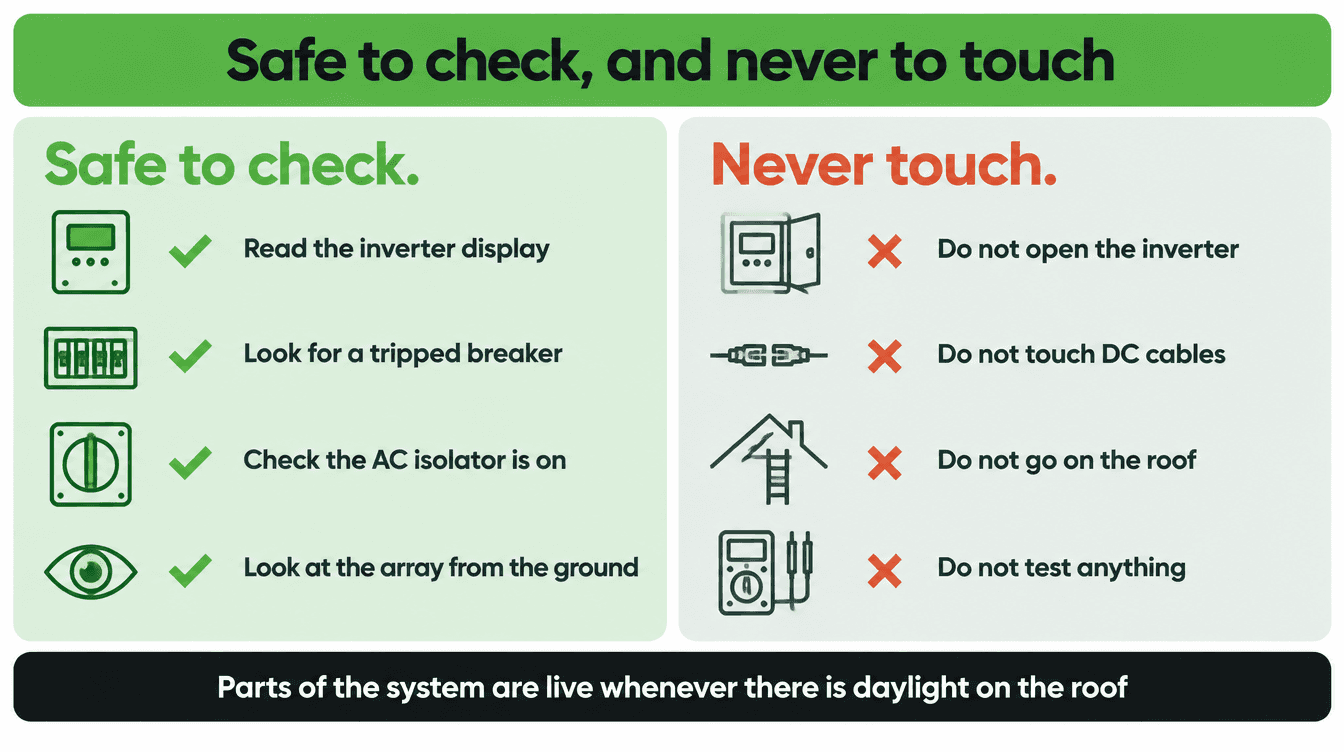
Solar panels are not like other appliances. The UK fire and rescue services' own operational guidance puts it bluntly: parts of the system are always live while the modules are exposed to daylight. Switching off the AC isolator disconnects the inverter from your house. It does not make the DC side safe. Nothing does, while the sun is up.
So:
Never open the inverter, remove a cover, or unscrew any enclosure. Aside from the shock risk, manufacturers exclude opened equipment from warranty.
Never touch, unplug or try to reseat DC cables or connectors, including anything hanging loose or looking damaged.
Never go on the roof. Look from the ground, from a window, or with your phone's camera zoomed in.
Never do electrical testing. No multimeter, no opening the consumer unit beyond operating the switches on its front.
Do not keep resetting the inverter to clear a fault that keeps coming back. A recurring fault is telling you something.
If you can see or smell burning, scorching, melted plastic, a discoloured isolator or water inside an enclosure, do not touch it. Switch off the AC isolator only if it is safe to reach, and call an engineer. If there is fire or smoke, call 999.
Everything that follows stays inside those limits.
Step 1: is it generating, or just not reporting?
Your monitoring app is a reporting device. It sits alongside the system and sends data out; it is not part of the power path. When the app dies, the system usually carries straight on.
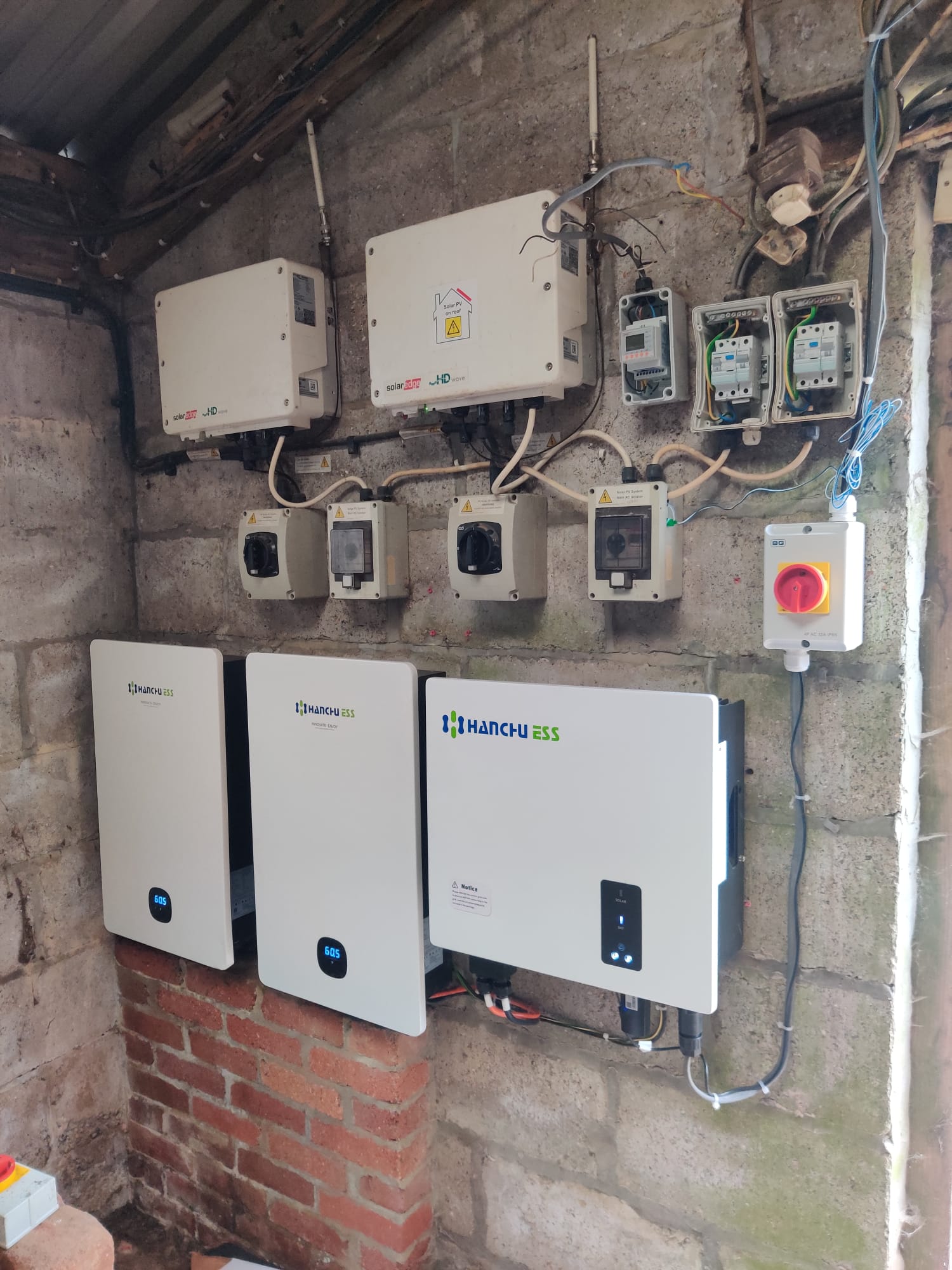
Go and look at the inverter itself. Every inverter has either a display showing current output and today's total, or status LEDs. If the inverter shows normal operation and a sensible figure for the time of day, you have a monitoring problem, not a generation problem. Your generation meter, if you have one, is the other cross-check: if the numbers are still climbing, the panels are working.
Monitoring drops out for boring reasons, and these four cover most of it:
You changed your router. New router, new network name, and the system's Wi-Fi dongle has nowhere to connect. One manufacturer's own guidance suggests naming the new router the same as the old one with the same password, which lets the dongle reconnect on its own. A good trick.
You changed the Wi-Fi password. Same effect.
You moved to a combined 2.4 and 5 GHz network. Most solar Wi-Fi dongles connect only to 2.4 GHz. If the two bands were split and are now merged, or the router pushed the dongle onto 5 GHz, it will drop.
Signal strength. These dongles are usually in a garage, a loft hatch cupboard or an outside wall, the worst places in the house for Wi-Fi. Manufacturers typically want a solid signal at the dongle; an extender often fixes it permanently.
There is also a fifth: the manufacturer's own servers go down occasionally, and when they do, thousands of systems show nothing at once. The giveaway is the same one as above: the inverter itself is fine. Our guide to monitoring your solar panels through an app goes further.
If the inverter shows nothing, no light and no display at all, go to step 2.
Step 2: the safe checks, and this is the whole list
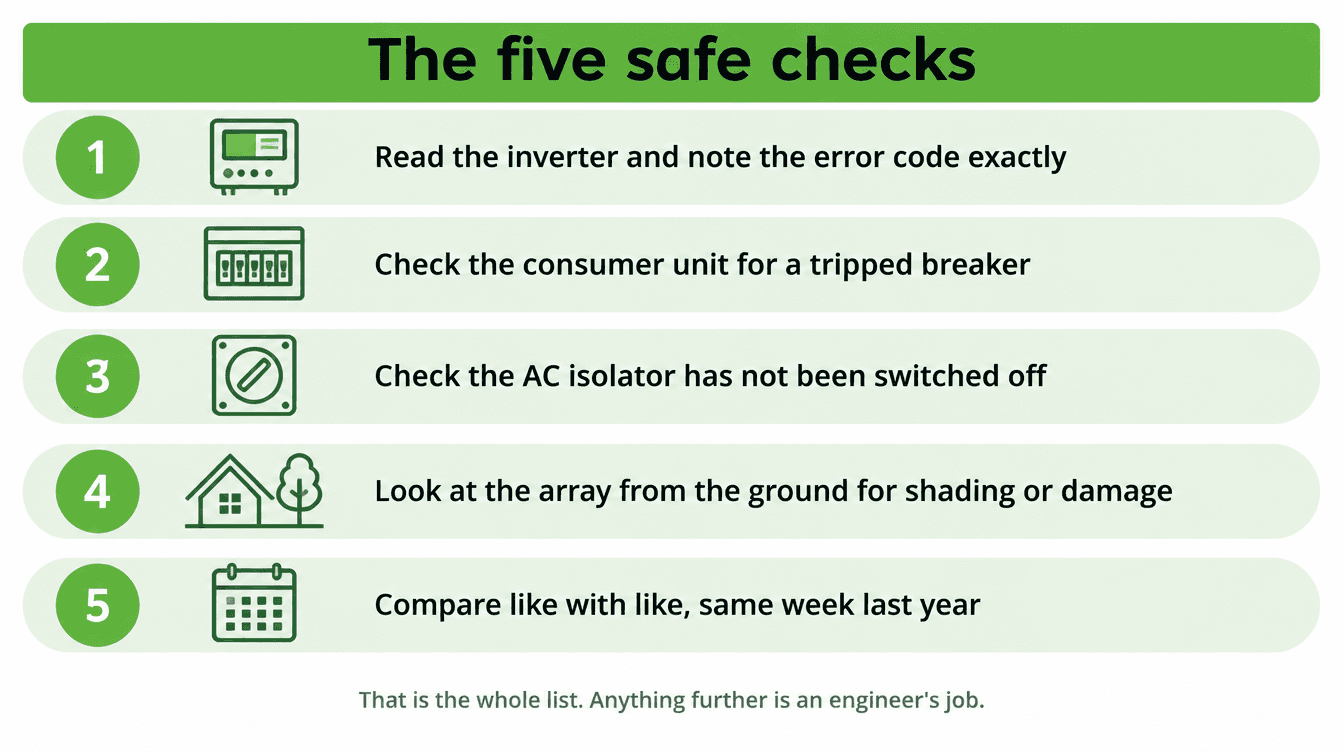
Read the inverter. Note any error code or message exactly as it appears, including numbers. It is the single most useful thing you can tell an engineer.
Check the consumer unit. Look for a tripped breaker or RCD on the circuit serving the solar. Reset it once. If it trips again, stop: something is causing it and repeated resetting is not a fix.
Check the AC isolator. There is usually a labelled rotary switch near the inverter or the meter. It gets switched off by builders, decorators and electricians doing other work, and then nobody switches it back on. Turning it back on is safe; opening anything is not.
Look at the array from the ground. Obvious shading from a tree that has grown, a new neighbouring extension, scaffolding, bird nesting under the panels, a panel visibly dirty or damaged, anything hanging down.
Check the weather and the season against your own history. Compare like with like: this week against the same week last year, not against midsummer.
That is the list. It is deliberately short and it is deliberately exhaustive. If none of those explains it, the next step is an engineer, not a YouTube video.
Cutting out on sunny days? Check the grid voltage
If your system works in the morning, then cuts out around the middle of a bright day and comes back later, the cause may not be your system at all.
By law, the voltage delivered to your home has to sit between 216.2 V and 253 V. Your inverter's over-voltage protection is deliberately set higher than that, tripping at 262.2 V after one second. So if your inverter is tripping on over-voltage, the supply has already gone past the legal limit before the inverter even reacts, or your own cabling is adding too much rise on the way to it. Either way, it is not the panels, and raising the inverter's trip setting is not a fix.
Your network operator (for most of London, UK Power Networks) has a regulated duty to investigate a voltage complaint. We explain the numbers, what to gather and how the complaint works in why your inverter shuts down on sunny days.
"It is working, but the output looks low"
Before assuming a fault, check what you are comparing against.
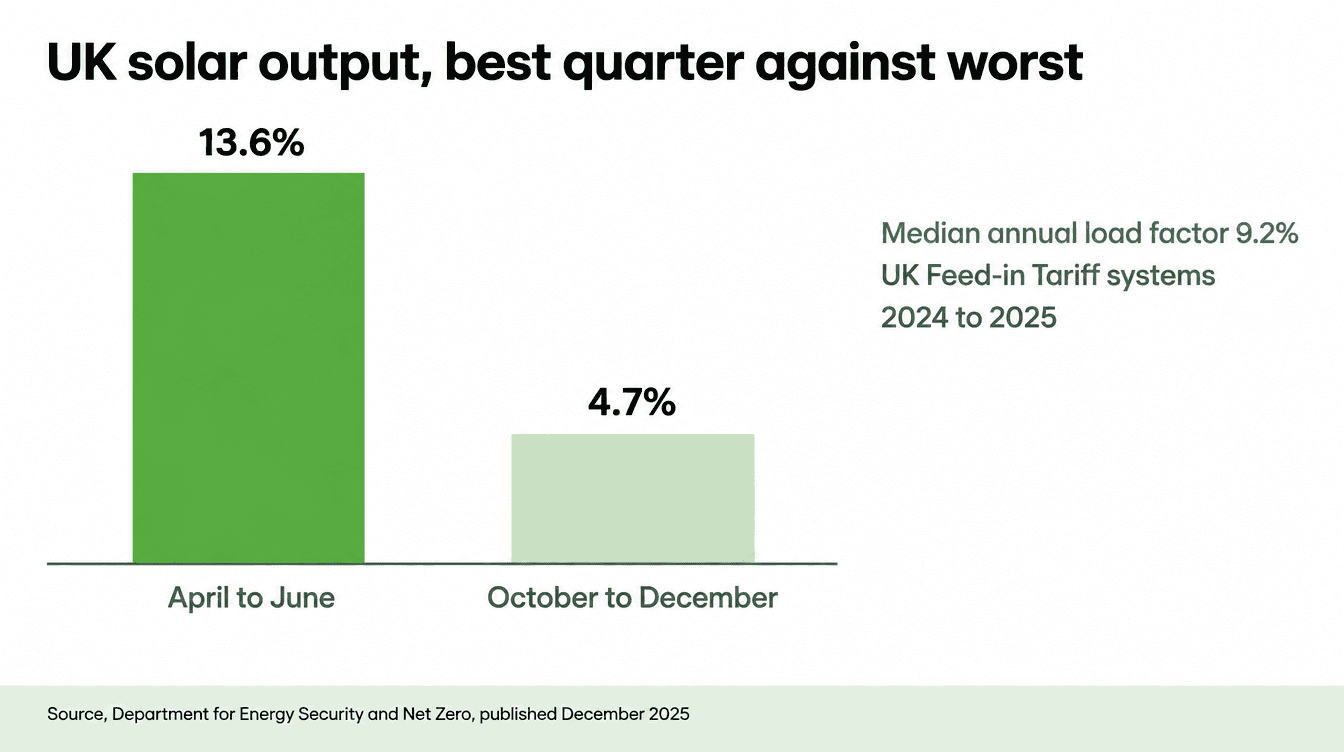
Season. UK solar output is heavily seasonal, and the official statistics show how heavily. The government's own analysis of Feed-in Tariff systems for 2024/25 puts the median annual load factor at 9.2%, with the best quarter (April to June) at 13.6% and the worst (October to December) at 4.7%. That is roughly a three-to-one difference between the best and worst quarters of the year. A December week that looks catastrophic next to July is very often completely normal.
The number on your paperwork. The generation estimate on your MCS certificate is an annual figure, produced by a standard method from your location, orientation, pitch and shading. It is not a monthly figure and it was never meant to be divided by twelve. Comparing one winter month against a twelfth of the annual estimate will always look alarming and means nothing.
Orientation. An east or west facing array typically produces meaningfully less than a south facing one across the year. If that is how your roof is, that is your baseline. Our guide to panel position and orientation covers why.
Cleaning. Less of an issue than the industry likes to pretend. The Energy Saving Trust's position is that in the UK, rain cleans panels pitched at 15 degrees or more. Real exceptions: heavy bird fouling, a shallow pitch, a flat roof, a dusty site, or a tree dropping sap. If the array looks clean from the ground, cleaning is probably not your answer.
And the decisive rule: a sudden drop is never degradation. Modern panel performance warranties allow around half a percent a year, gradually. If your output stepped down from one month to the next, or a string went from working to nothing, that is a fault. Degradation does not do that.
Faults that need an engineer
These are the faults that take test equipment and a qualified person. We are not going to attach percentages to them, because nobody publishes reliable figures on how often each occurs.
The inverter has reached the end of its life. This is the big one for FIT-era systems. The Energy Saving Trust's guidance is that a solar inverter needs replacing after around twelve years, and manufacturers' product warranties on inverters sit in the same region: a major manufacturer's standard inverter warranty runs twelve years against twenty-five on the panels. A system installed between 2011 and 2019 is now somewhere between seven and fifteen years old. If the panels are fine and the inverter has died, replacing the inverter brings the whole system back for a fraction of a new installation, and it is the natural moment to add a battery, because a hybrid inverter does both jobs. We cover that in our guide to adding a battery to existing solar.
DC isolators. The government-commissioned BRE study of fire incidents involving solar PV, covering July 2015 to February 2018, found 80 incidents against roughly 937,000 UK installations, about 0.01%. Of those, DC isolators were the single largest component category, and the root cause was overwhelmingly poor installation rather than faulty products: water getting in through cable glands, multiple cables forced through a gland designed for one, mounting holes drilled through weathertight seals. Rooftop isolators exposed to a decade of British weather are worth looking at on any older system, and a discoloured or water-stained isolator is something to report, never to touch.
Mismatched connectors. The plug-and-socket connectors joining panels look interchangeable and are not. The leading manufacturer's position is unambiguous: intermating connectors from different manufacturers "severely endangers the safe operation of a PV plant", causing cracks, water ingress and rising contact resistance, and at worst can lead to a fire. The damage is not always visible at first glance. It is a known risk wherever panels have been added or replaced in a hurry.
Everything else (a failed string, a dead optimiser on a SolarEdge system, a bypass diode, water in an enclosure, rodent or bird damage to cabling) is what an inspection is for. It is diagnosed with test equipment, not by guessing.
If your installer has gone out of business
Many FIT-era installers no longer trade, and that does not leave you without options.
Another MCS-certified installer can take the system on. You do not need the original company's permission or paperwork, and you are not stuck.
Look for your insurance-backed guarantee before you pay anyone. Reputable installations came with an IBG covering the workmanship warranty for its full term. If the installer has ceased trading, the insurance provider arranges the inspection and repairs covered by that policy. Your policy documents are usually with your original paperwork or referenced on your MCS certificate, and the consumer body RECC can help you identify the provider if you cannot find it. Most providers want a defect reported within a set window of discovery, so do not sit on it.
If you bought on finance, the finance provider may be jointly liable for a breach of contract, with an escalation route to the Financial Ombudsman.
Do not assume MCS will resolve it. MCS certifies the installation. It is the insurance-backed guarantee that survives the installer, not the certificate.
And if you are on the Feed-in Tariff, tell your licensee when equipment changes. Ofgem requires FIT generators to notify their licensee when generating equipment or a meter is replaced, added or removed. Replacing an inverter does not put your accreditation at risk, but it does need reporting, and we will tell you exactly what to send.
Frequently asked questions
My solar stopped after a power cut. Is it broken?
Usually not. Inverters disconnect when the grid fails and normally restart themselves once the supply is stable, though some take several minutes. If it has not come back after a few hours of daylight, check the AC isolator and the consumer unit, then call us.
The app says zero but the inverter has a green light.
That is a monitoring fault, not a generation fault. Work through the router and Wi-Fi checks above. Your electricity bills will tell you the truth in the meantime.
Can I just clean the panels myself?
Please do not go on the roof. Beyond the fall risk, walking on modules causes micro-cracks you cannot see and cannot undo. If the array genuinely needs cleaning we do it from the ground with a pole-fed brush and deionised water: no detergents and nobody on the array.
Is there a recall on my panels?
We are not aware of any current UK safety notice or recall affecting domestic solar panels. If you have seen something online, it is worth checking whether it refers to the UK at all, because some widely shared stories are from other countries.
How long should my panels last?
The panels themselves are the most durable part of the system: twenty-five years or more is the normal expectation, and their performance warranties run on that timescale. It is the inverter that is the consumable, at around twelve years.
Do I need a service every year?
Not legally, and we will not pretend otherwise. But on an older system that nobody has looked at since installation, problems like degraded isolators and corroded connections can go unnoticed while quietly losing output. What an annual service covers is set out on our solar servicing page.
Book a solar system inspection
If you have worked through the safe checks and the system still is not right, we will come and find out why. We service and repair systems we did not install, across London and the surrounding counties, and we will tell you honestly whether it is worth repairing or replacing.
Tell us roughly when the system was installed, what the inverter is showing, and your postcode.
Book a solar system inspection or call 020 3026 5032.
Facts in this article were checked against ESQCR 2002, Energy Networks Association, Energy Saving Trust, BRE, RECC, Ofgem and manufacturer documentation. Some of it is date-sensitive and we review it regularly.
Latest Articles






Ready to Start Saving with Solar?
Get your free no-obligation quote today. Our experts will design the perfect system for your home.
Free Home Survey
MCS Certified
Finance Available


Quick Links
Services
Contact
© 2026 Solar Panels London. All rights reserved.