Rated 4.8 on Trustpilot
Read Reviews

·
Faults & Servicing
Why Does My Inverter Shut Down on Sunny Days?
Losing generation at the wrong time usually points at one thing: your local network voltage. What is happening, why it is not your panels, and what your network operator must do about it.
By
Solar Panels London
·
Last reviewed
It is a strange thing to watch. Clear sky, middle of the day, and your solar system stops. An hour later it is running again. The panels are fine, the inverter is fine, and nothing in the house has changed.
The usual cause is voltage. Not yours, the network's.
Your inverter is required to disconnect if the voltage at its terminals climbs too high, and on some properties it does exactly that, most often on bright days around midday. It is protecting itself and the network, and it is doing what the rules tell it to do. But it means you are losing generation at the best hour of the day, and there is a documented route to getting it fixed.
Key points
If your system cuts out on sunny days around midday and restarts later, high grid voltage is the most likely explanation.
Your inverter's trip point is deliberately set above the legal maximum voltage your network operator is allowed to deliver. So a compliant inverter on a compliant supply should not trip.
That said, long or undersized cable inside your own property can add voltage rise too, so it is not automatically the network's fault.
Your network operator has a statutory duty to investigate a voltage complaint, on a seven working day clock, with a compensation payment if they miss it.
Turning the inverter's trip setting up is not a fix. It removes the protection that proves the problem exists, and it cannot be done without the network operator's written agreement.
What is actually happening
To push electricity out of your house and into the network, your inverter has to sit at a slightly higher voltage than the network it is exporting into. Electricity flows from higher voltage to lower, so the inverter raises its output a little and the surplus flows away.
That works until the network voltage is already near the top of its permitted range. Then the inverter raises its output, runs out of headroom, hits its own limit and disconnects.
Three conditions have to coincide, which is why this is a sunny-day problem:
Maximum generation. Bright sun, panels at full output.
Minimum demand. Midday, nobody home, nothing drawing power, so almost everything you make is being exported.
A network already sitting high.
Take any one of those away and the problem disappears, which is exactly why it comes and goes and why it is so easy to dismiss.
The numbers, and why they matter
This is the part worth understanding, because it is what turns a frustration into a case.
UK supply voltage is legally defined. Under the Electricity Safety, Quality and Continuity Regulations 2002, a low-voltage supply is declared at 230 volts, and the permitted variation is no more than 10 per cent above and 6 per cent below. In practical terms the supply must sit between 216.2 and 253 volts. Both UK Power Networks and SP Energy Networks state that range on their own customer pages.
Your inverter's protection settings come from a different document, the grid connection standard your installer worked to. For a typical domestic system the over-voltage protection trips at 262.2 volts after one second, with a faster second stage higher up.
Look at those two numbers together. The inverter's trip point is set above the highest voltage your network is legally allowed to deliver. The grid code sets it roughly four per cent above the statutory maximum precisely so that a compliant inverter never trips on a compliant supply.
Which leads to the conclusion that makes this worth pursuing: if your inverter is genuinely tripping on over-voltage, the voltage it is seeing is above what the network is permitted to deliver.

One important caveat before you pick up the phone. The statutory limits apply at the supply terminals, which means your incoming cut-out, not your inverter. Between the two sits your own property's cabling. A long run, or a cable sized too tightly, adds its own voltage rise, and that rise is counted at the inverter but not at the cut-out. So an over-voltage trip means either the network supply is out of limits, or your own installation is adding too much rise on the way to the inverter. Both are worth finding. Only one of them is the network operator's problem.
That is the first thing we check, and it is the reason to have someone look before you complain.
Why it happens at some properties and not others
The physics is about impedance. The further electricity has to travel and the thinner the conductor, the more the voltage moves when current flows through it. So the properties that see this tend to have something in common:
A long service cable from the street to the property.
A position at the far end of a long low-voltage feeder, away from the local substation. Voltage falls along a loaded feeder, so the network is often set high at the transformer end to keep the far end above the legal minimum. That lifts everyone nearer the transformer toward the top of the range.
A lot of local solar. On a sunny afternoon a street full of arrays is all exporting at once, and all of them are pushing the local voltage up together.
Manufacturer technical guidance puts the same point more plainly: voltage rise at the inverter depends on the impedance at the connection, how much power is being exported, and what the grid voltage was to start with.
What you can safely check yourself
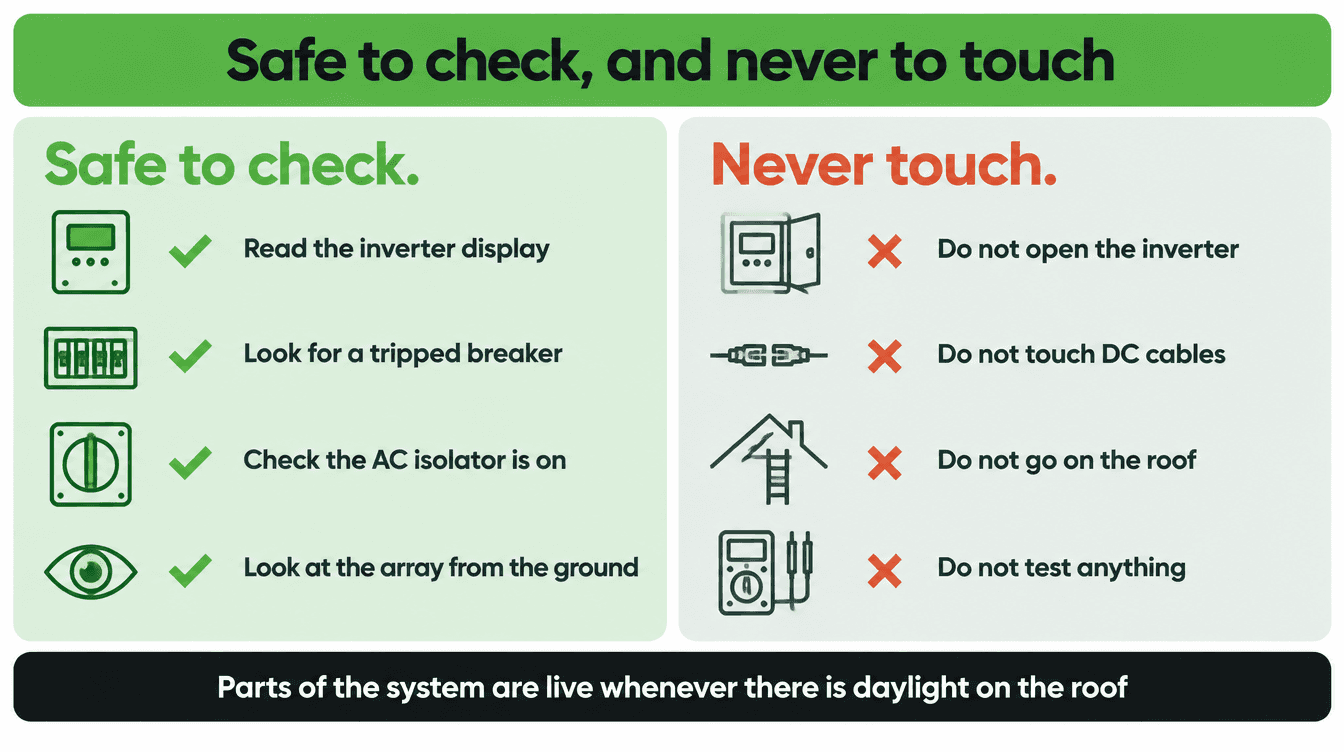
None of this requires opening anything.
Look at the pattern. Does it happen on clear days and not dull ones? Around the middle of the day? Does it clear by itself in the late afternoon? A fault that follows the sun is not a coincidence.
Look at the grid voltage in your monitoring app. Most inverters log it. You are looking for readings sitting near or above 253 volts, particularly at the times generation drops out. This is one of the most useful things you can gather.
Look at the generation trace. A system tripping on voltage produces a distinctive shape: output climbing normally, then flat-topping or dropping to nothing in the middle of a clear day, then recovering. Compare a sunny day with a cloudy one.
Look at the event log. Inverters record why they disconnected. An over-voltage event will be there with a timestamp.
Write it down. Dates, times, voltage readings, how long each outage lasted. Screenshots of the voltage graph from your app are worth more than any description.
What you must not do is open the inverter, the consumer unit or anything at the meter, or attempt any electrical testing. There is nothing to be gained there and the risk is real.
Your network operator has to investigate
This is the part worth knowing.
Investigating a voltage complaint is a guaranteed standard of performance, set in regulations, not a courtesy. If you report that the voltage at your property is outside the permitted range, your distribution network operator must respond within a defined period, and if they fail to they owe you a compensation payment.
In London that operator is UK Power Networks. Their published guaranteed standards state that where you report the electricity at your property is outside the permitted voltage range, they will contact you and arrange a visit within seven working days, or, where a visit is not necessary, provide a written response within five working days. If they miss it, a fixed compensation payment is due to you.
What they actually do, in their own description of the process: check whether there is a known network problem in your area, send an engineer to inspect the property and the equipment, and (this is the important bit) they may return to fit a recording device that monitors and measures your supply voltage for two weeks. They then analyse it and report their findings.
That logger is the evidence. Your inverter's data is what tells you to make the call; the network operator's own instrument is what settles it.
You can report a voltage problem to UK Power Networks through their website, or by phone on their 24-hour line. If you are outside London, the same duty applies to whichever operator covers your area.
What can and cannot be done at the property
There is one thing to be wary of. If anyone offers to solve this by raising your inverter's over-voltage trip setting, be careful.
The grid connection standard requires the protection to be set during manufacture, to be protected from unpermitted interference, and, in terms, that once the system has been installed and commissioned the protection settings are only altered following written agreement between the network operator and the customer.
Beyond the compliance point, it is not a fix. The trip is not the problem, it is the symptom. Turning it up removes the thing that proves your supply is out of limits, leaves your equipment running on a supply outside the legal range, and would be expected to put your installation's certification and possibly your equipment warranty in question.
What can legitimately be done at the property is to reduce the voltage rise inside your own installation. Shorter cable routes and larger conductor sizes between inverter and consumer unit both help, and manufacturers recommend exactly that. If the original cable run was long or tight, correcting it can resolve a borderline case on its own, and it is entirely within your control in a way that the street outside is not.
Which of those applies to your property is a site question. There is no generic answer, and anyone giving you one over the phone is guessing.
Frequently asked questions
Is my system broken?
Usually not. Over-voltage disconnection is the protection working as designed. The problem is what it is protecting you from.
Am I losing much generation?
It depends entirely on how often and how long it trips, and the only way to know is to read the data. Because it happens at peak production, an hour lost at midday costs more than an hour lost at either end of the day.
Will the network operator actually do anything?
They have a statutory duty to investigate, a deadline, and a payment if they miss it. Whether the outcome is a network change depends on what the logger shows.
Can I just accept it?
You can, and some people do. But it will not improve on its own, and if the local network is getting more solar on it, it is more likely to get worse than better. Using more of your own generation on site, for example with battery storage, reduces how much you export at midday, though it does not fix the supply itself.
Could it be something else?
Yes. Other faults produce midday dropouts, and low generation has plenty of other causes. That is what an inspection establishes.
What if my own cable is the problem?
Then it is fixable, and fixable by us rather than by a complaint. That is the better outcome of the two.
What we would do
Read the inverter's voltage history and event log, and establish whether the trips are genuinely voltage-related. Measure the voltage at the inverter and at the board, and work out how much of the rise is happening inside your property and how much is arriving that way. Check the cable route and size against what the installation actually needs. Confirm the protection settings are intact and have not been altered.
If the evidence points at the network, you get a written report to send with your complaint. If it points at the installation, we tell you what it would take to put right.
Book a solar system inspection. If your system is cutting out on the days it should be working hardest, it is worth finding out why.
Latest Articles






Ready to Start Saving with Solar?
Get your free no-obligation quote today. Our experts will design the perfect system for your home.
Free Home Survey
MCS Certified
Finance Available


Quick Links
Services
Contact
© 2026 Solar Panels London. All rights reserved.