Rated 4.8 on Trustpilot
Read Reviews


·
Faults & Servicing
Why Is My Solar Generating Less Than It Used To?
Before you assume a fault, make a fair comparison. 2025 was the UK's sunniest year on record, so this year can look worse with nothing wrong. Here is how to tell weather from a real problem, and what the real problems usually are.
By
Solar Panels London
·
Last reviewed
Often the answer is the weather, not a fault. 2025 was the UK’s sunniest year since records began in 1910, so a system that seems to be doing worse in 2026 may simply be having a more ordinary year.
That said, a real drop in output does happen, and it usually has a findable cause: shading that has grown, dirt or nesting birds, part of the array that has stopped working, or an inverter that keeps cutting out. The first job is to make a fair comparison. Then you’ll know whether there is anything to find.
Key points
Compare the same month with the same month last year, never November with July.
2025 was a record year for sunshine, so 2026 can look down with nothing wrong.
Panels do lose a little output each year, but slowly. A sudden or large drop isn’t ageing.
A tree, a neighbour’s extension or nesting pigeons can take a real chunk out of generation.
If one section of the array has stopped working, output falls by a noticeable step, often on sunny days.
Never go on the roof or clean panels from a ladder. Report it and let an engineer look.
First, make a fair comparison
Compare like with like
UK solar output swings enormously through the year. Government analysis of metered output from Feed-in Tariff solar systems found that typical output in October to December 2024 was around a third of what it had been in April to June 2024. Comparing a winter month with a summer one tells you nothing.
Compare a month with the same month last year. Better still, compare whole years or a run of several months, because a single dull fortnight can drag one month down.
Remember what last year was like
Year-to-year differences are bigger than most people expect.
2025 was the UK’s sunniest year on record, according to the Met Office, beating the previous record set in 2003. England had its sunniest year on record, and spring 2025 was the sunniest spring on record.
The year before was unusually dull. Government analysis found that sun hours in 2024/25 were at their lowest since 2012/13, and October to December 2024 was the lowest-output winter quarter in the series.
So a system can look worse this year against 2025, and look better against 2024, with nothing changed on the roof. If your drop roughly matches how much sunnier last year was, that’s probably all it is.
Use the right numbers
The generation meter, or the inverter’s lifetime total, is more reliable than the app’s daily graph. Apps can miss days when the Wi-Fi drops. If you’re on the Feed-in Tariff, your generation meter readings are a long, trustworthy record.
Check for gaps. If the app shows flat days with no data at all, that’s a monitoring problem, not lost generation. Our guide to monitoring your solar panels through an app explains how to tell.
Compare with your MCS estimate, which should be in your handover pack. It’s an estimate for a typical year, so a single year above or below it isn’t proof of anything. A system that falls well short year after year is worth looking at.
What normal ageing looks like
Solar panels lose a small amount of output each year. Manufacturers put a number on it in the performance warranty. One current example, for Aiko panels (a brand we fit), guarantees at least 99% of rated power in the first year, then allows a loss of 0.35% a year, leaving at least 88.85% of rated power in year 30.
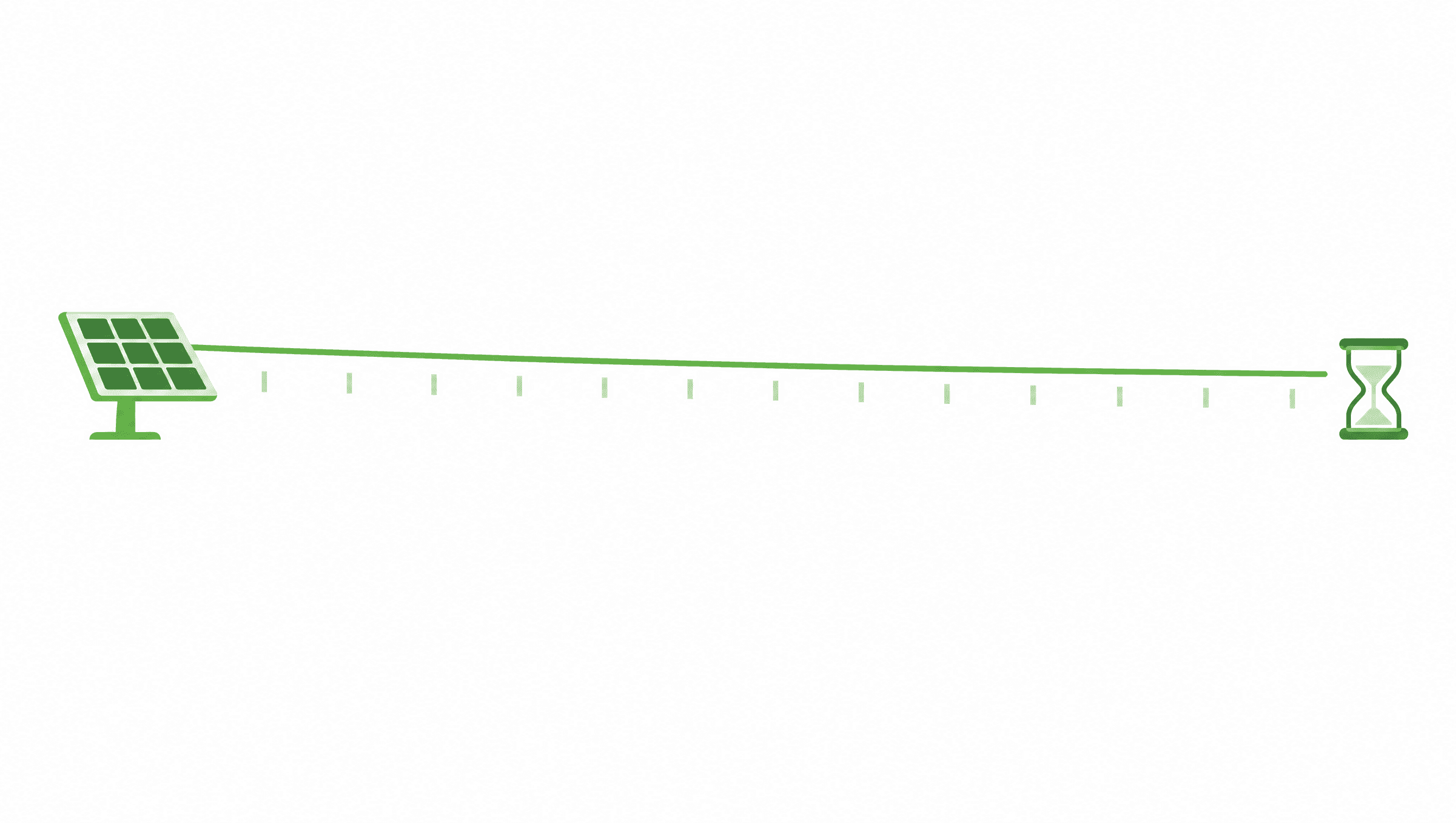
Warranties differ between brands and older panels were often warranted to lose more, so check your own datasheet. But the principle holds. Ageing is slow and steady. It doesn’t explain a drop you can notice from one year to the next.
Causes worth checking
Shading that has grown
Shade costs more output than many people expect, and it creeps up slowly. A tree that has grown a few feet, a neighbour’s loft conversion or rear extension, or scaffolding left up next door can all shade part of the array for part of the day. Look at your roof from the street or garden at different times of day, especially morning and late afternoon.
On a system without optimisers or microinverters, shade on part of a string can pull down the output of the whole string.
Dirt, droppings and nesting birds
Rain keeps most pitched-roof panels reasonably clean. Flat or low-pitch panels, panels under trees, and panels near busy roads collect more. Bird droppings and lichen don’t wash off on their own.
Pigeons nesting under the panels are a separate problem. They bring droppings and nesting material onto the panels and can damage the cabling underneath. Our guide to pigeon-proofing solar panels covers the signs and the fix.
If panels do need cleaning, the Energy Saving Trust recommends doing it from the ground with a gentle hose or brush, never a pressure washer, and using a professional if you can’t reach safely from the ground. Never stand on the panels or work on the roof yourself.
Part of the array has stopped working
Many systems are wired as two or more strings of panels, each feeding its own input on the inverter. If a connector fails, a cable is damaged or an optimiser stops working, one string can produce much less or nothing at all while the rest carries on.

The giveaway is a step change. Output drops by a noticeable fraction and stays down, most visibly on bright days. Some apps show each input separately. If one has dropped well below the other on a sunny day, and both used to match, that’s worth reporting.
This needs an engineer. The panel side of a solar system carries DC voltage whenever there’s daylight, even with the inverter switched off.
The inverter is cutting out or holding back
Shutting down on sunny days. If your local grid voltage runs high, the inverter is required to disconnect to protect the network, then reconnects later. You lose generation at exactly the best times of day. Our guide to why inverters shut down on sunny days explains how to spot it.
An export limit. If your system has an export limit and no battery to soak up the surplus, the inverter reduces output when you’re not using much in the house. Our guide to solar export limits explains why limits are set.
Heat. Some inverters reduce their output when they get too hot, for example in a loft or a sun-baked spot in a heatwave.
A setting or firmware change. If the drop started around a firmware update, a battery being added or other electrical work, that’s a useful clue.
An inverter that is failing. Warning lights, repeated restarts and unusual noise are covered in our guide to signs your solar inverter is failing.
It’s not generating at all
If output has dropped to nothing, rather than just less, start with our guide to solar panels not generating.
What you can safely check yourself

Compare the same month or season with last year, and with the year before if you can.
Take a generation meter reading, or note the inverter’s lifetime total, and compare it with earlier readings.
Check the app for days with no data.
Read the inverter display or status light and note any code. Take a photo.
Look at the panels from the ground for shade, dirt, droppings or signs of pigeons.
On a bright day, check whether the app shows each input (string) separately and whether one is well below the other.
Note when the drop started and anything that happened around then: building work, a firmware update, a new battery, a storm, a tree growing back after a cut.
Do not go on the roof, clean the panels from a ladder, pressure-wash them, open the inverter, or touch any cabling. Solar panels produce DC voltage whenever it’s light, and that can’t be switched off at the consumer unit.
When to book an inspection
Book an inspection if:
output is clearly down on the same period last year, and last year wasn’t especially sunny
one string or section is producing well below the others on a bright day
the inverter shows a fault, keeps restarting or cuts out on sunny days
you can see damage, nesting birds or new shading you can’t deal with from the ground
the system has fallen well short of its MCS estimate for more than one year
An inspection can include checking each string’s voltage and current against what it should produce, looking for damaged cables, connectors or optimisers, thermal imaging to find hot spots, reading the inverter’s fault log, and checking its settings and any export limit.
Frequently asked questions
How much less is normal from one year to the next?
After the first year, ageing on modern panels accounts for a fraction of a percent a year. Weather can account for far more than that. Compare with how sunny each year was before assuming anything is wrong.
Is it worth cleaning my panels?
Only if they’re visibly dirty, and only from the ground. Rain keeps most pitched-roof panels reasonably clean. Droppings, lichen and debris under trees are the usual reasons to clean.
My output dropped after a battery was fitted. Why?
It might not have. Adding a battery can change how the app measures and displays generation. Compare generation meter readings rather than the new app with the old one. If the meter shows a real drop, ask the installer to check the settings.
Can you look at a system you didn’t install?
Yes. We inspect and repair systems whoever fitted them.
Book a solar system inspection. If your system is producing less than it should, we’ll find out why and tell you what it will take to fix.
Latest Articles




Ready to Start Saving with Solar?
Get your free no-obligation quote today. Our experts will design the perfect system for your home.
Free Home Survey
MCS Certified
Reply in 1 Working Day


Quick Links
Services
Contact
© 2026 Solar Panels London. All rights reserved.