Rated 4.8 on Trustpilot
Read Reviews

·
Faults & Servicing
Pigeon-Proofing Solar Panels
Pigeons love the sheltered gap under solar panels. What the law says about nests, how mesh guards work without drilling your panels, and why the timing matters.
By
Solar Panels London
·
Last reviewed
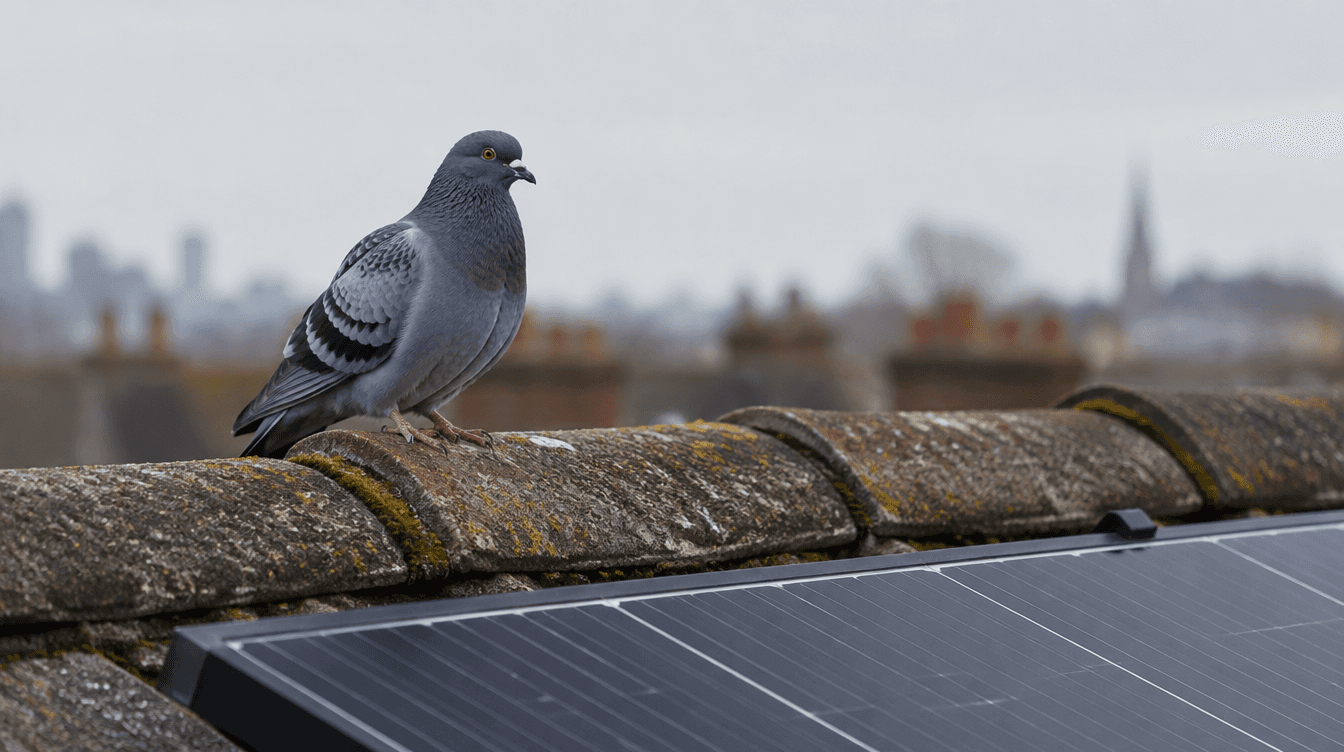
The gap between solar panels and the roof is sheltered, dry and out of reach of predators, which makes it an attractive place for pigeons to roost and nest. Feral pigeons naturally nest on ledges, and the RSPB notes they use sites under bridges and on roofs as stand-ins for the cliff ledges their wild ancestors used.
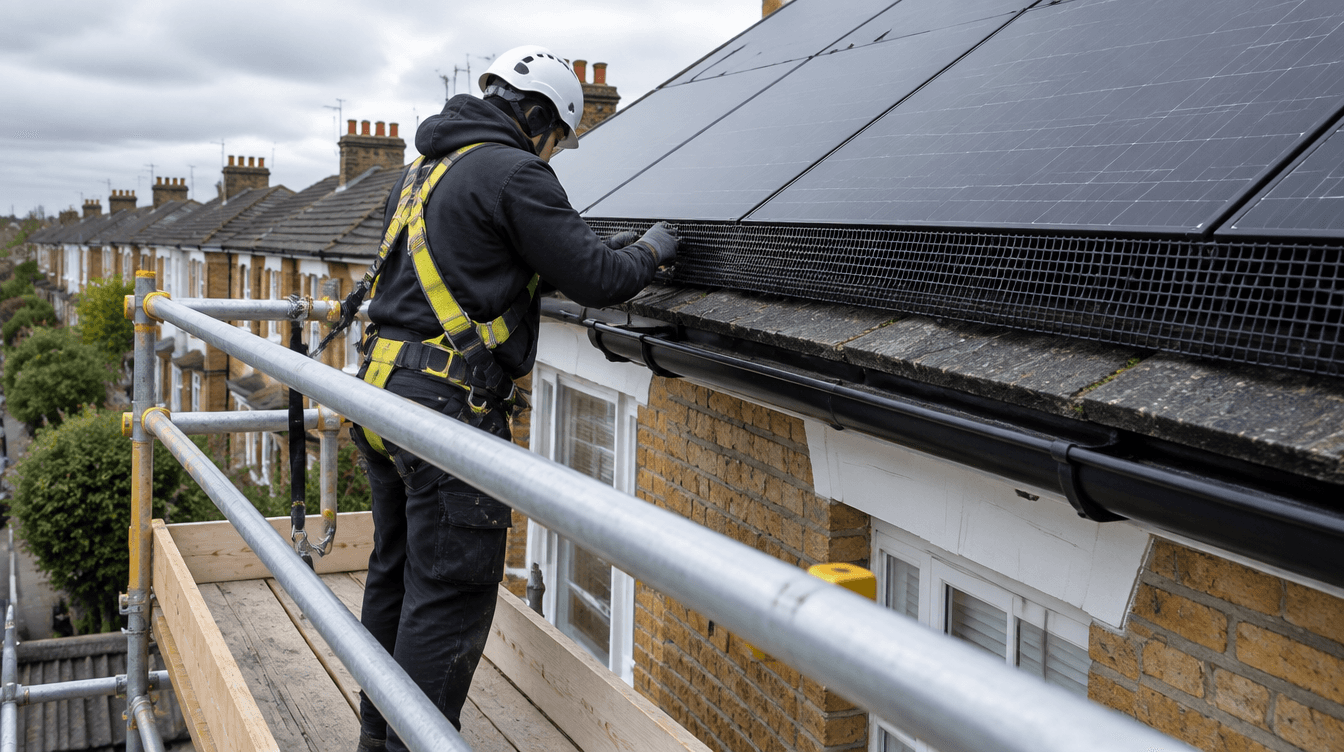
Pigeon-proofing closes that gap. It is usually done with a mesh guard fitted around the edge of the array. Done properly, it does not involve drilling into the panels, and it has to be timed around the law protecting nests.
Key points
The space under panels suits pigeons because it is sheltered and hard to reach.
A mesh guard around the edge of the array keeps birds out.
It is an offence to damage or destroy a wild bird's nest while it is in use or being built. Feral pigeons are wild birds.
Pigeons can breed several times a year, so every job needs a check for active nests first.
This is work at height. It needs proper access, not a ladder and a hopeful afternoon.
Why it matters
Feral pigeons can raise several broods a year. When they nest under an array, nesting material and droppings build up underneath the panels, where they are hard to reach and clean, and the birds can be noisy. Many homeowners simply do not want pigeons living on the roof above their bedroom.
Pigeon-proofing is also easier to do before nesting gets established than after.
What the law says
This part matters.
Under the Wildlife and Countryside Act 1981 it is an offence to intentionally kill, injure or take any wild bird, to take, damage or destroy the nest of any wild bird while it is in use or being built, or to take or destroy its eggs. Feral pigeons are wild birds and are covered.
Natural England issues general licences that allow certain action against a small number of species, including feral pigeons, for specific reasons such as public health or safety. Those licences also point to bird-proofing buildings and structures as an alternative way of dealing with the problem.
In practice:
Fitting mesh when no nest is in use does not interfere with an active nest, eggs or birds. The RSPB describes netting to stop birds nesting as legal in most cases, but says it cannot be used on nesting sites that are already in use.
An active nest with eggs or chicks must not be disturbed. The job waits until the nest is no longer in use.
Pigeons can breed several times a year, so there is no single safe season. Each job starts with a check.
If there is any doubt about what is permitted, Natural England's guidance on wild birds and general licences is the authoritative place to look.
How pigeon-proofing works
The usual method is a mesh guard clipped around the perimeter of the array, closing the gap between the panel edges and the roof.
A proper job generally involves:
Checking under the array for active nests before anything else.
Clearing out old nesting material and debris from under the panels.
Fitting the mesh around the whole perimeter, fixed with clips designed for the purpose, so the birds cannot get back in at a gap.
On your panel warranty: panel manufacturers' installation manuals generally say the module frame must not be modified, and some exclude warranty cover for damage caused by non-compliant mounting. Clip-on mesh is designed to attach without drilling. We have not found manufacturer guidance that addresses clip-on bird mesh specifically, so if your panels are still under warranty it is worth checking your manufacturer's manual. What you should never accept is anyone drilling into the panel frames.
Other birds on London roofs
Gulls also nest on London rooftops. Herring gulls are on the UK's red list of birds of highest conservation concern, and they are not among the species covered by Natural England's general licence for public health and safety. Anything beyond excluding them when no nest is in use needs an individual licence.
Swifts are also red-listed and have declined sharply. They return from Africa in late April and May and tend to come back to the same nest sites every year, usually in eaves and gaps in buildings. The RSPB's guidance is that where swifts are nesting, building work must not damage, block or prevent access to their nest sites. If you know you have swifts, tell whoever is working on your roof.
Why it is not a DIY job
Pigeon-proofing means working at the edge of a roof, around electrical equipment. The Health and Safety Executive's guidance on roof work says almost one in five deaths in construction involve roof work, that sloping roofs require scaffolding with edge protection at the eaves, and that ladders are only suitable for short tasks measured in minutes.
It is also worth having someone look at the rest of the system while they are up there. The cabling under the panels and the condition of the roof around the array are much easier to inspect with the right access in place.
Frequently asked questions
Will mesh damage my panels?
Clip-on mesh is designed to fit without drilling the panels. Check your manufacturer's manual if your panels are under warranty, and never accept drilling into the frames.
Can you remove a nest?
Not while it is in use or being built. Old, unused nesting material can be cleared as part of the job.
When is the best time of year?
For pigeons there is no single season, because they can breed several times a year. The right time is when there is no active nest, which is what the check before the job establishes.
Do I need planning permission?
Not normally. If your home is listed, check with your council first.
Book a solar inspection. If birds have moved in under your panels, we can check the array, clear it out safely and fit a guard to keep them out.
Latest Articles


Ready to Start Saving with Solar?
Get your free no-obligation quote today. Our experts will design the perfect system for your home.
Free Home Survey
MCS Certified
Finance Available


Quick Links
Services
Contact
© 2026 Solar Panels London. All rights reserved.