Rated 4.8 on Trustpilot
Read Reviews

·
Solar Panels
Solar Panel Oversizing Explained
Why fitting more panels than the inverter can output is a normal design choice, what clipping really costs, and how it helps with network approval.
By
Solar Panels London
·
Last reviewed
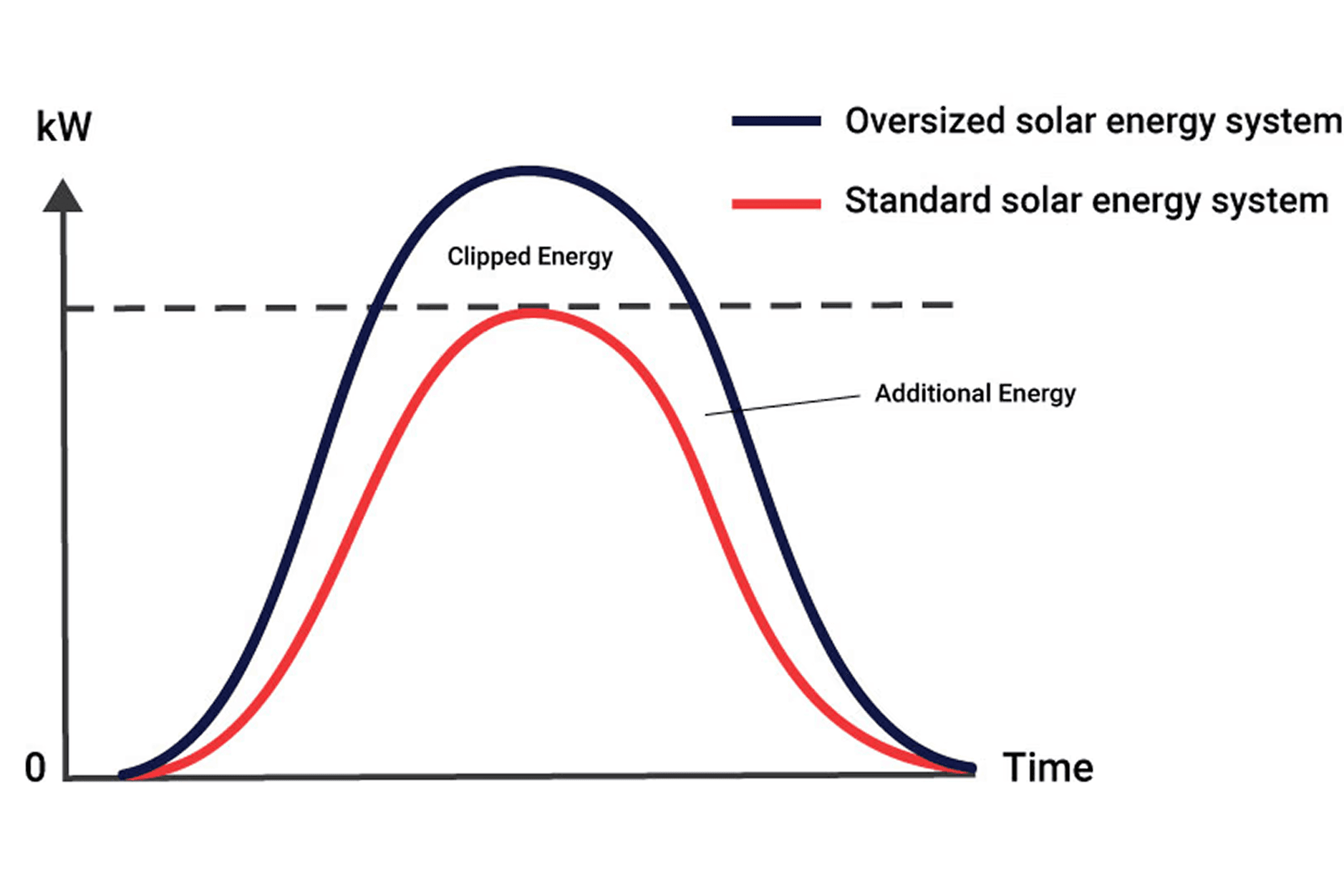
Oversizing means fitting more panel capacity than the inverter can output. A 5 kWp array on a 3.68 kW inverter is a typical example. On a bright summer midday the panels could produce more than the inverter can pass on, and that surplus is "clipped". For the rest of the year, which in the UK is most of it, the extra panels lift output in the weaker light. That is why oversizing is a normal, sensible design choice rather than a mistake.

What clipping actually costs you
Panels only reach their full rated output in strong sun with cool cells, which in the UK happens for a limited number of hours each year. Clipping only bites in those hours. In the mornings, evenings, winter and on cloudy days, the larger array produces more than a smaller, “matched” array would, and the inverter is working closer to its rated output for more of the day.
How much is clipped depends on the ratio of panels to inverter, the roof direction and pitch, and shading. A system designer can model it for your roof, which is the only honest way to answer how much a particular design gains or loses.

Why oversizing helps with network approval
The rule that decides whether a system can be connected and notified afterwards (G98), or needs approval first (G99), is based on the inverter's output: 16 amps per phase, which is 3.68 kW on a normal single-phase home. It is not based on the size of the panel array.
So a larger array on a 3.68 kW inverter can stay within the simpler G98 route. Our guide to solar export limits, G98 and G99 explains the rule in full, including why it is the total across your whole property that counts.
Batteries and oversized arrays
With a hybrid inverter, the battery is usually charged on the DC side, from the panels, before the power is converted to AC. Depending on the inverter, that can let some of the surplus that would otherwise be clipped go into the battery instead. Whether it does, and how much, depends on the specific inverter's design, so it is worth asking about when you compare quotes. Our battery storage page covers the systems we fit.
Things to weigh up
Peak output is capped by the inverter. A smaller inverter limits how much power the system can deliver at once, including from the battery into the house.
Export may be limited anyway. In some areas the network operator sets an export limit, which affects design choices.
Future plans. If an electric car or heat pump is coming, it may be worth designing for more inverter capacity from the start.
Manufacturer limits. Every inverter has a maximum DC input the manufacturer allows. A good design stays within it.
Related guides
To get a feel for what system size suits your usage, see typical energy usage and recommendations and what size solar battery you need.
Thinking of extending a system you already have? Our guide to adding more solar panels to an existing system explains when spare inverter capacity helps and when it doesn’t.
Every system we quote is designed for the specific roof and household. Request a solar and battery quotation and we will explain the panel and inverter sizing we recommend, and why.
Latest Articles



Ready to Start Saving with Solar?
Get your free no-obligation quote today. Our experts will design the perfect system for your home.
Free Home Survey
MCS Certified
Reply in 1 Working Day


Quick Links
Services
Contact
© 2026 Solar Panels London. All rights reserved.