Rated 4.8 on Trustpilot
Read Reviews


·
Solar Panels
Buying a House With Solar Panels: What to Check
Who owns the panels, what paperwork should come with them, how the Feed-in Tariff transfers and whether the system is actually working. A checklist for buyers, and what to do on the day you move in.
By
Solar Panels London
·
Last reviewed
Solar panels can be a real plus on a house you are buying, but they come with questions your conveyancer and you should ask before completion. The most important is who owns them. After that, it is about paperwork, the Feed-in Tariff, and whether the system actually works.
Key points
Find out whether the panels are owned outright or installed under a lease of the roof space. Leased panels need your lender’s consent.
Ask for the paperwork through your conveyancer: MCS certificate, electrical certificate, network operator notification, warranties and any Feed-in Tariff statements.
Feed-in Tariff payments stay with the property. You claim them from the FIT licensee with evidence that you now own the house.
Smart Export Guarantee contracts don’t transfer. You sign up for your own.
An inspection tells you whether the system is working and what condition it is in.

Are the panels owned or leased?
This is the question that matters most, so ask it first.
Owned outright means the panels belong to the house and pass to you with it.
Leased means a company installed the panels, often free of charge to the original owner, under a long lease of the roof space. The company owns the panels and usually keeps the Feed-in Tariff payments. The homeowner gets free daytime electricity.
A roof-space lease is a legal interest in the property, so it affects your mortgage. UK Finance says most lenders’ mortgage conditions require the lender’s consent to any lease, and its Mortgage Lenders’ Handbook sets out lenders’ requirements for roof-space leases. Your conveyancer will check the lease against those requirements and with your lender. Leave plenty of time for this, as it can hold up a purchase.
The paperwork to ask for
Ask the seller, through your conveyancer, for as much of this as exists:
MCS certificate. This is the evidence the system was installed to the MCS standard. You’ll need it for export payments.
Electrical Installation Certificate for the solar work.
Network operator notification or approval (G98 or G99). Our guide to solar export limits and DNO approval explains what these are.
Feed-in Tariff statements and the name of the FIT licensee, if the system is on the FIT.
Warranties: panels, inverter, battery and the installer’s workmanship warranty, plus any insurance-backed guarantee.
The handover pack: system design, datasheets and serial numbers.
Monitoring app details, so the account can be moved to you.
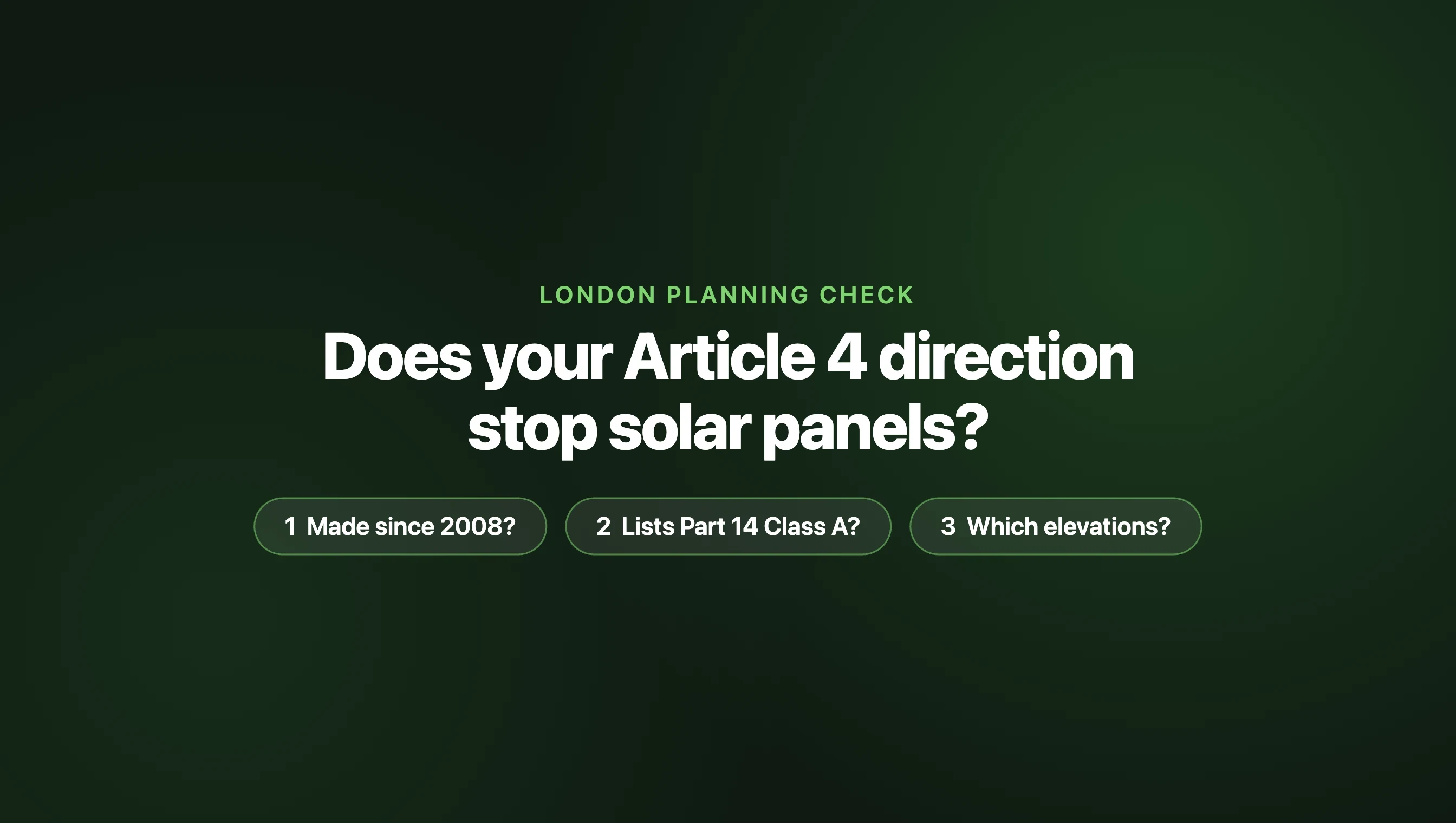
Planning permission, if the house is listed or covered by an Article 4 direction. Our Article 4 directions list shows where that applies in London.
If the original installer has closed, much of this can still be recovered. Our guide to what happens when your solar installer has gone bust explains how.
Taking over the Feed-in Tariff
Feed-in Tariff accreditation belongs to the property, so on an owned system the payments can pass to you.
Contact the FIT licensee named on the seller’s statements. Each licensee has its own change of ownership form.
Send evidence that you now own the house. The Energy Ombudsman lists a copy of the sale and purchase agreement as an example. If you can’t find what you need, your conveyancer may be able to provide it.
Get the records from the seller. Ofgem’s guidance says it is the new owner’s responsibility to get the records they need from the previous owner, so ask for the FIT paperwork and a meter reading on completion day.
If there is a dispute over who owns the installation, the licensee assesses the evidence, and you can take an unresolved complaint to the Energy Ombudsman.
Our guide to keeping your Feed-in Tariff when you upgrade covers what happens to FIT if you later add a battery or more panels.
Export payments if the system isn’t on the FIT
Smart Export Guarantee contracts are between the previous owner and their supplier, so they don’t come with the house. You apply to a SEG supplier yourself. You’ll need a meter that can provide half-hourly export readings, usually a smart meter, and evidence that the installation and installer were MCS certified. That is another reason to get the MCS certificate before completion.
Warranties
Manufacturer warranties are given by the manufacturer, not the seller, so check the terms for whether they transfer to a new owner and whether the products were registered. The same goes for the installer’s workmanship warranty and any insurance-backed guarantee: check whether it transfers, and how long it has left.

Is it actually working?
Ask the seller for recent generation readings or a screenshot from the monitoring app, and compare them with the estimate on the MCS paperwork. Remember that output changes hugely with the seasons and from one year to the next.
Also ask how old the inverter is. Inverters don’t last as long as panels; the Energy Saving Trust puts a typical inverter life at around 10 to 15 years.
The surest answer is an inspection, before or soon after you complete. Our guides to signs your solar inverter is failing and why solar generates less than it used to explain what to look for.
On the day you move in
Take a photo of the generation meter, and the export meter if there is one, with the date.
Contact the FIT licensee, or a SEG supplier if the system isn’t on the FIT.
Move the monitoring account into your name. If you can’t, the manufacturer’s support team can help.
Register or transfer any warranties that allow it.
Book an inspection if one wasn’t done before completion.
Frequently asked questions
Do solar panels make it harder to get a mortgage?
The main issue is leased panels, which need your lender’s consent. Your conveyancer will check.
Who gets the Feed-in Tariff payments after I buy?
On an owned system, you do, once the FIT licensee has your evidence of ownership.
The seller doesn’t have the MCS certificate. Is that a problem?
It can often be traced. The MCS helpdesk can help find a certificate, and you’ll need it for export payments.
Can you inspect a system on a house I’m buying?
Yes. We inspect systems whoever installed them.
Book a solar system inspection. We’ll check the panels, inverter and any battery, and tell you what condition the system is in.
Latest Articles





Ready to Start Saving with Solar?
Get your free no-obligation quote today. Our experts will design the perfect system for your home.
Free Home Survey
MCS Certified
Reply in 1 Working Day


Quick Links
Services
Contact
© 2026 Solar Panels London. All rights reserved.